
 Jon Wilner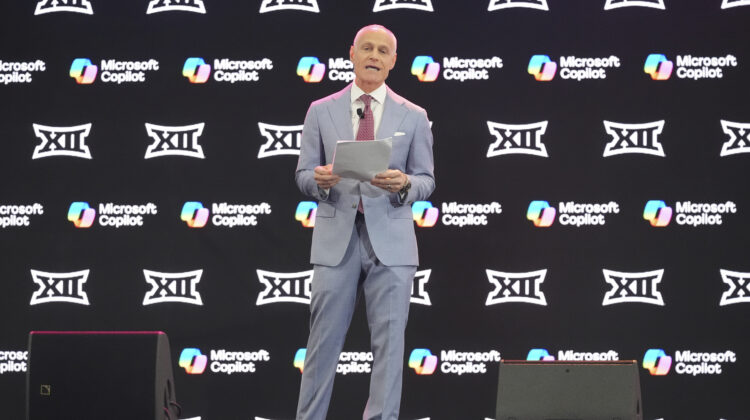
Big 12 commissioner Brett Yormark didn’t slam the brakes on College Football Playoff expansion during his state-of-the-conference remarks Friday in Frisco, Texas — that authority belongs exclusively to the Big Ten and SEC. But Yormark injected a morsel of common sense that had previously been in short supply.
The Big 12 favors a 24-team playoff field “directionally,” he told reporters at the conclusion of the conference’s spring business meetings. Beyond that level of support, more information on both the economics and unintended consequences of expansion is needed.
“We haven’t had a lot of discussion around 24,” Yormark said, referring to the 10 FBS conference commissioners and Notre Dame’s athletic director. “Now, we have to do the work and see where it takes us.”
The measured tones stand in contrast to the approach taken by Big Ten commissioner Tony Petitti, who is fully on board with the 24-team field and, during an hour-long discussion with reporters last week in Southern California, never mentioned the threat of unintended consequences. (If the CFP expands to 24, there’s no going back.)
It seems Yormark has staked out a position between Petitti’s all-in view of 24 and SEC commissioner Greg Sankey’s ongoing skepticism. Sankey prefers 16 but hasn’t ruled out 24. He, too, wants to examine the data before reaching a conclusion:
— How much revenue would the additional 12 games generate from media partners?
— Would the added dollars be enough to offset the loss of revenue from conference championships, which would be eliminated?
— What impact would a massive playoff field have on the sport’s ultra-valuable regular season?
There’s this, too: Would a 24-team playoff create the right circumstances for the Big 12 to implement a 10-game conference schedule?
The Big 12 has played nine league games and three non-conference games for 15 years, but external forces are making the math more challenging.
The SEC and ACC have moved from eight to nine conference games (starting this season), reducing the inventory available for Big 12 teams.
And if the CFP expands to 24, the Big Ten and SEC could explore a scheduling partnership that would generate significant TV revenue but further diminish the Big 12’s opportunities for high-level non-conference matchups.
The 10-game league schedule was discussed this week, and Yormark said the concept needs “to be further explored.”
Meanwhile, a public spat involving one of the Big 12’s member institutions this week illuminated the need for the conference to consider alternate schedule models.
Texas Tech coach Joey McGuire, responding to criticism of his team’s schedule by Texas coach Steve Sarkisian, offered to play the Longhorns in Week 1.
“We’re willing to buy our contract out of (Abilene Christian),” McGuire told assembled reporters in Frisco. “I’m sure because Texas has got a lot of money, they can buy their contract out, but I do know there’s a lot of Red Raiders that could help them buy that contract out if they don’t want to, and they can come to Lubbock in Week 1.”
Yes, it was the most transparent of challenges: Even if the logistical issues could be overcome, there is no chance Texas would agree to play the Red Raiders with a showdown against Ohio State the following week — and everyone knows it.
McGuire’s sparring was quite rich for another reason: Texas Tech’s non-conference schedule oozes creampuffs.
Last year, the Red Raiders played Arkansas-Pine Bluff, Kent State and Oregon State.
This season, they play Abilene Christian, Oregon State and Sam Houston.
Next year, their non-conference schedule features Arkansas-Pine Bluff and New Mexico. The third opponent is to-be-determined after NC State canceled a home-and-home series with the Red Raiders — a decision directly related to the ACC’s move to nine conference games.
According to fbschedules.com, Texas Tech won’t face a power conference opponent until 2030, when it begins a two-game series with Arkansas.
The absence of marquee non-conference matchups in upcoming seasons is, in fact, an issue across the Big 12 — partly because schools are hesitant to take on heavyweight opponents and partly because several home-and-home series with SEC and ACC schools have been canceled. (No program has been hurt more by cancellations than Arizona State.)
All in all, the majority of Big 12 teams either have non-conference openings starting in 2027 or a slew of matchups with Group of Six and FCS programs. There are precious few must-see dates with elite Power Four opponents.
Why not fill the void with a 10th conference game regardless of the CFP format decision.
The added intra-league game would undoubtedly generate larger TV audiences than routine non-conference matchup, thereby elevating the Big 12’s media value in advance of the next round of contract negotiations at the end of the decade.
The strategy is cost efficient, as well: Big 12 schools would not have to pay $1 million (or more) for so-called buy games against lower-level opponents.
And it would bolster strength-of-schedule metrics for playoff contenders.
Yes, the extra conference game would add eight losses to the Big 12’s overall ledger, which could undermine its CFP prospects. But consider: It’s the only power conference that hasn’t received an at-large bid in the two years of the 12-team CFP.
The Big 12 is healthy, but its football product is not thriving — at least not based on playoff participation and success.
Forget idle salvos fired at Texas from Lubbock. Those do nothing for the Big 12’s on-field product. (Yormark called it “noise.”)
Whether the playoff stays at 12 or expands to 16 or 24, the Big 12 should explore every last option to improve its postseason positioning.
*** Send suggestions, comments and tips (confidentiality guaranteed) to wilnerhotline@
*** Follow me on the social media platform X: @WilnerHotline
Related posts:
 Pac-12 football ROI: Deion Sanders becomes the third highest-paid coach as Colorado antes up
 Pac-12 recruiting preview: Class rankings, portal support, UCLA’s rise, the ‘Coach Prime’ effect and NIL matters
 Pac-12 media rights: Kliavkoff under pressure as saga nears conclusion and presidents express optimism

(AP Photo/Tony Gutierrez, File)
Big 12 football TV lineup: Where (and when) to find the games on ESPN, Fox and TNT