 Sports360AZ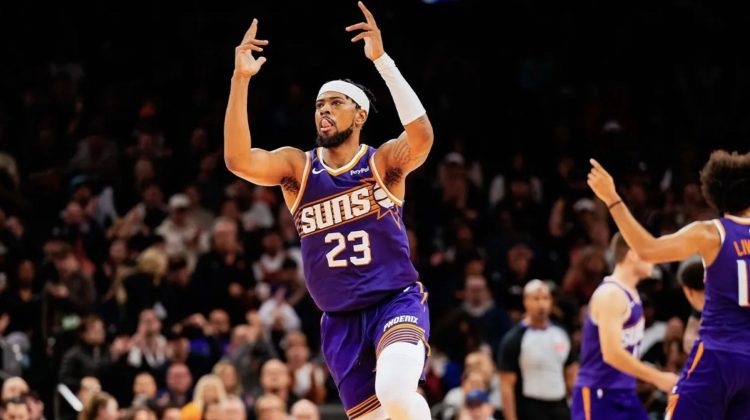
By Gerald Bourguet
The NBA offseason is everyone’s favorite time of year to speculate and dream. We’ve already had to shoot down trade rumors surrounding Giannis Antetokounmpo and Ja Morant, and despite how much fun it is to imagine landing distressed assets like Dejounte Murray or Zion Williamson, the more likely scenario is that this Phoenix Suns team looks largely the same next season.
Say what you will about owner Mat Ishbia or general manager Brian Gregory, but they’ve been pretty transparent over the last two years about what their approach will look like. Last summer, they admitted the Big 3 experiment didn’t work, were forthcoming about their inevitable pivot, and pledged to field a more competitive, gritty team that would at least make the fanbase proud again.
One new head coach, roster overhaul, 45-win season and playoff appearance later, they delivered on what they promised and laid a new foundation. Now, heading into Year 2 of this retool, their comments during exit interviews revolved around continuity and player development.
“Do we take calls about opportunistic trades and ideas? Of course we do,” Ishbia said during exit interviews. “However, our massive, massive lean is, I like this team. I like where we’re going. I like the direction of the organization. I like the culture that we’ve built. I like the identity that we have. And we’re not gonna do anything silly to mess that up.
“We’re gonna continue to lean in on that, and I think the fans will be proud of that. And we’re gonna continue to get better and we’re gonna build something special for years to come here in Phoenix. And I think this was the foundational first year.”
There’s certainly a case to be made against complacency, but regardless of how aggressive the Suns ultimately decide to be in another important offseason, their three main free agents warrant the front office’s attention first and foremost. In terms of keeping this team intact, the work obviously begins with navigating potential new deals for Collin Gillespie, Jordan Goodwin and Mark Williams.
Next week we’ll shift gears to Williams’ restricted free agency, and we already covered what type of contract to expect for Gillespie, but today we’ll be honing in on Jordan Goodwin, another unrestricted free agent with Early Bird rights.
The Suns’ cap situation
The Suns already have eight players under contract for next season: Devin Booker, Jalen Green, Dillon Brooks, Grayson Allen, Royce O’Neale, Khaman Maluach, Ryan Dunn and Rasheer Fleming. If you include the non-guaranteed deals and team options for players that would make sense to return, three more are added to that total with Haywood Highsmith, Jamaree Bouyea and Oso Ighodaro.
Between those 11 players, Phoenix already has approximately $162.5 million on the books. Unfortunately, they also have the dead money for Bradley Beal, Nassir Little and EJ Liddell to worry about. That extra $23.2 million in dead money bumps them up to $185.7 million in total salary.
For reference, the NBA’s salary cap for next season is $165 million, which means the Suns will operate as an over-the-cap team. Thankfully, they can go over the cap to re-sign Goodwin because they possess his Early Bird rights, which allows them to re-sign their own free agents to a higher amount without regard to the salary cap. (This is the case with Collin Gillespie as well.)
What they’ll need to consider is the luxury tax at $200.5 million and the first apron at $209.1 million. Mat Ishbia never blinked while staring down astronomical luxury tax bills when he thought his team was worth the investment, but if the Suns dive back into the tax next season after ducking it this year, they’ll be subject to the repeater tax again.
Fortunately, that’s an Ishbia problem, and the Suns owner has never minced words about how fans couldn’t care less about their favorite team’s tax bill. So if this organization truly is all aboard the Continuity Express, they may not have any choice but to dive back into the tax, since re-signing just one or two of their key agents could quickly push them back over that $200.5 million threshold.
Remember, the Suns are only operating with $14.8 million of space beneath that luxury tax line. If Gillespie re-signs for an annual salary in the $10-13 million range like we’re projecting, retaining him and Goodwin would likely be enough to push Phoenix back into tax territory before the Suns even fill out their final two roster spots.
A look at Jordan Goodwin’s career year
Like Gillespie, Jordan Goodwin is coming off a career year with the Suns. His 8.7 points, 4.9 rebounds and 1.5 steals in 22.5 minutes per game over 70 appearances all represented career highs, and he even shot a respectable 37.1 percent from 3-point range on 4.3 attempts per game — both career highs as well.
That offensive growth helped Goodwin become a lot more playable, pairing all his trademark hustle plays and hounding defense with someone who was an actual, viable contributor on the other end, which wasn’t the case during his first Phoenix stint.
Everyone who watched a single game of Suns basketball could see what Goodie brought on the defensive end and why he was so vital to Phoenix’s new identity. The 27-year-old won the team’s Dan Majerle Hustle Award, and for good reason, as a defensive menace who shouldered the Suns’ toughest defensive assignments and wreaked havoc for 94 feet up and down the court.
In fact, Goodwin ranked eighth in the entire NBA in deflections and 13th in steals despite playing at least 300 fewer minutes than all 12 players ahead of him. His 2.7 steal percentage ranked in the 94th percentile at his position as well, per Cleaning The Glass.
That all-gas-no-brakes approach and constant defensive pressure helped set the tone for a top-10 Suns defense that ranked fourth in steals, third in opponent turnovers and fifth in points off turnovers, and his absence was felt in that respect in all 12 games that Goodie missed.
Goodwin also continued to be maniacal force on the offensive glass, which is where the Suns got the most offensive value out of him during his last stint. Goodie actually led the league in offensive boards among all players 6-foot-4 and under,and he ranked sixth in O-boards among all players, period. He wasn’t just some opportunist either; Goodwin ranked second among all qualified players 6-foot-4 and under in contested offensive rebounding percentage too.
According to Cleaning The Glass, Goodie rebounded a whopping 8.1 percent of his team’s missed field goals when he was on the court…as well as a staggering 9.6 percent of Phoenix’s missed free throws when he was out there. Both figures ranked in the NBA’s 98th percentile among guards, and they prove how his crash mentality didn’t change for a second when he was on the floor.
But what really made this such a standout season was the offensive growth we alluded to in the beginning. Coupling all of that hustle and grit with above-average 3-point efficiency totally changed his outlook as a valuable role player.
Goodwin’s progress as a 3-point marksman deserves recognition, especially as a guy who was a career 32.3 percent shooter from deep before this season. The improved efficiency is particularly impressive because it came with a sizable increase in volume as well:
- Jordan Goodwin first 4 NBA seasons: 328 3-point attempts in 150 games
- Jordan Goodwin in 2025-26: 302 3-point attempts in 70 games
Goodie built on his 29-game stint with the Los Angeles Lakers to become a reliable spot-up threat, knocking down 38 percent of his catch-and-shoot 3s. Considering 245 of his 302 attempts were of that variety, it’s no wonder his final 3-point percentage looked so good.
Goodwin also made 42.5 percent of his “wide open” 3s, and he still has room for growth as a shooter, given that he’s 27 years old and only made 34.9 percent of his corner 3s.
Perhaps the biggest area for improvement, though, is continuing to round out his offensive game, especially with his efficiency at the rim or developing an in-between shot. Goodwin isn’t much of a midrange or pull-up threat, he doesn’t really have a reliable floater, and he only shot 53.1 percent at the rim — well below the league-average 60.4 percent. That number needs to improve for a guy who took nearly one-third of his shots at the basket.
However, there is some promise in this area, since Goodwin routinely embraced contact, converting 30 percent of his 3-point play opportunities (which ranked in the 78th percentile at his position).
So how much will Jordan Goodwin’s next contract be worth?
Add it all up, and Jordan Goodwin is the type of energy player any team could use, and he’ll be valued by a Suns team that rebuilt its identity around the grit, defensive tenacity and hustle that Goodie embodies every time he steps on the court. His value is a little more difficult to peg, given that Gillespie will likely be Phoenix’s top priority, but he’s earned himself a nice little raise from his veteran minimum contract.
According to a source who spoke with Suns After Dark, the Suns are confident they’ll be able to retain both Gillespie and Goodwin, despite how expensive they might wind up being since “several teams” have interest in them.
Something in the bi-annual range (which comes with a starting salary of $5.5 million and can only extend for up to two years, with 5 percent raise in Year 2) might make sense as his floor. In terms of his ceiling, a three-year or four-year extension in the $7-9 million range isn’t out of the question either.
For reference, using the bi-annual exception or the non-taxpayer mid-level exception would require Phoenix stay beneath the NBA’s first tax apron, which comes in at $209.1 million. Either way, unless the Suns manage to sign one or both of these free agents to lower-value deals than we’ve projected so far, re-signing them would likely push Phoenix back into the luxury tax.
That’s probably not an issue for Ishbia, but if the Suns do manage to re-sign Gillespie and Goodwin, the question then shifts to: Will they find a way to retain Mark Williams without climbing past the first apron?