
 Sports360AZ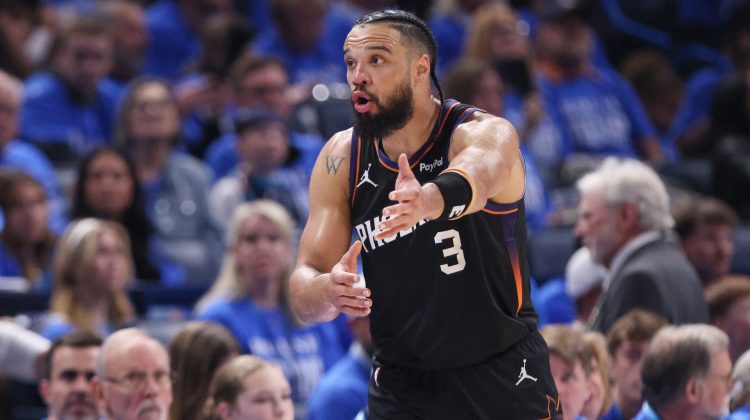
By Gerald Bourguet
One doesn’t earn a nickname like “Villain” without living on the knife’s edge between impactful and detrimental. Igniting a team’s competitive fire without letting it burn down everything in its path has always been a delicate balancing act for Dillon Brooks, but perhaps just as important is finding the sweet spot between self-belief and irrational confidence.
Now, facing the top-seeded Oklahoma City Thunder in the first round of the 2026 NBA Playoffs, the Phoenix Suns need the Villain who helped get them here to understand and embrace his role in their story it if they want it to continue for much longer.
Outside of Devin Booker and Jordan Ott, there was no catalyst more impactful for the Suns’ feel-good turnaround than Brooks. A team that was expected to wallow in a rebuilding phase near the bottom of the Western Conference became one of the NBA’s biggest pleasant surprises, finishing seventh in the West, winning 45 games, and earning a playoff berth as the 8-seed.
While Booker remains the Suns’ undisputed best player, Brooks has been one of the biggest reasons behind Phoenix’s unexpected turnaround — both on and off the court.
Brooks has been acknowledged as a culture-changing role player by former coaches and teammates in Memphis and Houston before, but he never seems to receive credit for it until he gets a chance to win over his next fanbase. That’s certainly happened in Phoenix, where the 30-year-old veteran enjoyed a career year on yet another playoff team that was written off.
Perhaps just as importantly, he brought the edge, toughness and competitive fire that the Suns lacked over the last two listless seasons, living up to the identity that owner Mat Ishbia, general manager Brian Gregory and coach Jordan Ott spent all summer talking about.
“Just knowing him from afar, we knew that that competitive spirit would lift our group,” Ott said at Media Day. “Things we didn’t know is his work ethic backs it up. He’s not all smoke. I told it right to his face a couple weeks ago: He’s an incredible worker, one of the hardest workers I’ve seen.
“Every night, to go to war with someone like that is gonna help not only Book, but also our young guys and show them the way, that this is the way that we have to be. And a competitive advantage of ours is outwork, outplay, how hard we can play? He’s gonna be the leader of that every night.”
Aside from a 45-win season that might have cracked 50 if he hadn’t missed 26 games due to injury, Brooks backed up his “Villain” persona with a career-high 20.2 points per game. While the Suns navigated injuries to Booker and Jalen Green, Brooks helped carry the offense, taking a career-high 17.1 shot attempts per game and flashing his most complete (and irrationally confident) season yet as an iso scorer and post threat.
The eye test showed Brooks had been an underrated post scorer with an impressive turnaround jumper for years, but he took it to new levels in his first season with the Suns.
According to Cleaning The Glass, which excludes garbage time, Brooks placed in the 97th percentile in midrange shot frequency among wings, taking 50 percent of his shots from there. He made a respectable 46 percent of those looks, which placed him in the70th percentile.
Brooks also ranked in the 97th percentile in usage rating at his position, and despite never being mentioned in the same breath as the league’s most efficient scorers, he did finish the season ranked fourth among all players in points per touch (min. 40 games played).
During the All-Star voting process, it didn’t feel too outlandish to view Brooks as a fringe candidate. Collin Gillespie confirmed as much, shouting, “Tell everybody, we have two All-Stars on our team!” during a televised postgame interview following Brooks’ carer-high 40 points against the Detroit Pistons’ second-ranked defense.
Brooks described how he was in a “flow state” after that memorable performance in late January, and when he’sinthat kind of groove, the Suns become a lot more difficult to defend. Unfortunately, there may also be a ceiling on how much higher this team can climb with Brooks playing such a significant role…and Phoenix may be getting close to it already.
On the court, there’s no question that Brooks’ fractured hand zapped a lot of his momentum, as well as the Suns’. But the signs of regression after such a hot individual start were always lying beneath the surface, and they’ve helped drag Phoenix’s offense back to the depths.
For starters, Brooks may be shooting the second-best field-goal percentage of his career, but that mark is only 43.5 percent. He’s only made 34.4 percent of his 3s, which has been a disappointment coming off a year in Houston where he shot a career-high 39.7 percent from deep on similar volume.
After converting an uncharacteristic 72 percent of his looks at the rim over the first few months of the season, he finished the year at a subpar 54.3 percent at the basket. He went from the NBA’s 85th percentile in points per possession on post-ups through those first two months to the 60th percentile. And while his efficiency on turnaround jumpers (53.6 percent) and fadeaways (48.3 percent) was still impressive, both figures represented a five percent drop from where they were just a few months earlier.
All of this turned a certified post-up/iso weapon that Phoenix could whip out on occasion into a notably less efficient option. Throughout the year, Ott backed up Brooks during his off shooting nights, due to the work ethic he possesses.
“He struggles early, he’s like, ‘I gotta get the ball up,’ he figures out himself,” Jordan Ott said. “That’s what really good, professional basketball players do. And we’re gonna ride with him when he’s missing, ’cause we can’t hop on when he’s only making. So everything he’s about is what we wanna be about. It’s not a surprise because of the work he’s put in.”
However, at a certain point, it’s a coach’s job to find a way to strike the right balance between empowering irrational confidence while still finding a way to rein it in a bit. Since returning from a month-long absence, Brooks’ settings never reverted, which made the reintegration process alongside Booker and Green a bumpy, rushed process. The Suns only had a handful of games in April to try and get everyone acclimated before the play-in, and the tunnel vision has gotten worse, with Brooks routinely operating like Phoenix is still missing its top scorers.
That was on full display in Game 1 against the Thunder, who just so happen to rank first in defensive rating and second in points per possession allowed on isos. None of that information stopped Brooks from launching some ill-advised shots, including a truly audacious step-back jumper on Phoenix’s first possession in a bizarre attempt to set the tone:
Brooks finished Game 1 with 18 points on 6-of-22 shooting, including 3-for-10 from 3. He took five more shots than Booker, and six more than Green. Unless the actual shooting numbers align with the “flow state” that Brooks seems to perpetually dwell in, that shouldn’t happen — especially if the majority of his shots are coming on contested 2s trying to go iso against the NBA’s stingiest defense.
“I don’t think our ball movement was great,” Ott said after Game 1. “We can’t iso this team. We can’t hold the ball against this team. We can’t take tough 2s all night against this team. We gotta find high-quality shots, and that’s been our thing the whole season.”
That was clearly a point of emphasis that’s fully sunk in heading into Game 2…right?
“I think it is, but I’m gonna iso Shai [Gilgeous-Alexander] when I get a chance to,” Brooks told AZ Central’s Duane Rankin with a smirk.
In fairness, Brooks finished the year ranked in the league’s 69th percentile in points per possession on isos, so it’s not like he’s incapable. The Suns need him to bail them out on some possessions, and even with Booker and Green on the floor, having a third creator who can attack mismatches and make Gilgeous-Alexander work on both ends is a necessity against this high-caliber defense.
As Brooks later added on a more serious note, there is a balance to moving the ball and isolating against matchups that the Suns deem favorable.
“You need a good balance of it, especially with this team,” he explained. “They’re gonna force you to make passes, to make shots, and that old-school basketball. That’s the only way we’re gonna break down their defense — or any defense, for that matter. So there’s gonna be times where we’re gonna be in iso and get our shots late in the shot clock, but we gotta be unselfish and find a way to share the basketball.”
The challenge, then, will be finding the right spots for Brooks to attack behind Booker and Green in the pecking order, which isn’t easy to do on the fly against the NBA’s No. 1 defense. That 35-point beatdown in Game 1 suggests this could be a short series, even if Phoenix makes all the right adjustments for Game 2 and beyond.
But it would behoove Brooks and the Suns to get closer to figuring out that right balance, because as much as this year’s team is ahead of schedule, taking the next step toward contention will be much more difficult. Brooks is 30 years old, and he only has one year left on his contract beyond this season.
That means the Suns will quietly wrestle with an important decision behind the scenes over the next few months: Has Brooks done enough to earn an extension this summer, which he’s eligible for? Or will his warts, age and current trade value as a useful veteran on an expiring $21 million contract prompt Phoenix to consider moving him in the near future?
As fun as this season has been, the goal is to put a title contender around Devin Booker before his prime is over. From the chip on his shoulder to his most impressive scoring season yet, Dillon Brooks has played an undeniably instrumental role in getting the Suns back on course, but plenty of teams will have interest in the mercurial two-way swing man, and a big, multi-year extension for a role player in his early 30s who operates like a go-to scorer seems a bit rich.
If Brooks’ irrational confidence continues to look incompatible with this team’s main pillars en route to a first-round sweep, Phoenix may be hurtling toward its ceiling with the Villain sooner than expected.
Related posts:
 Got Their Guy: Knight on Suns Radar Long Before Trade Deadline

Devin Booker shoots as Aaron Gordon defends (AP Photo/David Zalubowski)
What Are They Saying? Suns Bring The Heat, Defeat Denver 116-102
(AP Photo/Matt York)
REPORTS – Deandre Ayton traded to Portland in 3-team deal Suns 2023-24 training camp begins