
 Jon Wilner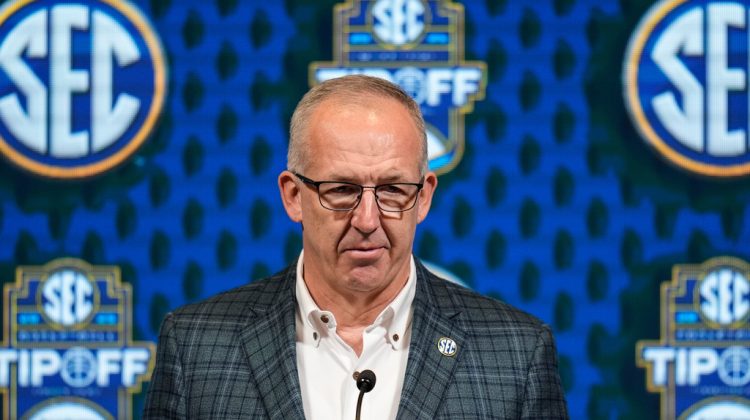
The most anticipated comments of talking season, commissioner Greg Sankey’s state-of-the-SEC remarks Monday morning, addressed the meatiest of issues facing intercollegiate athletics, including playoff expansion to the potential for his conference to break away from the NCAA.
At the same time, Michigan announced athletic director Warde Manuel is stepping down and negotiations over a groundbreaking bill on Capitol Hill took a strange, perplexing twist.
Welcome to July in college sports, where the offseason news is non-stop and every development seemingly ripples from conference to conference, up and down the food chain.
Manuel’s departure from the Michigan post, set for the end of the calendar year, will undoubtedly spark a frenzy among ambitious power conference athletic directors while the future of the Senate’s controversial Protect College Sports Act could impact conference realignment. (The latest: lawmakers are considering placing a 19-school cap on conference membership.)
And sure enough, Sankey’s remarks to open SEC media days in Tampa did nothing to temper the sense of enormity enveloping the industry — the expectation that the distant future of college sports could be shaped in coming months, if not weeks.
His comments offered incremental clarity on a topic that has divided fans, leagues and even TV networks for more than a year: the future format of the College Football Playoff.
Of the 10 major college conferences, nine favor moving to a 24-team event — for the Big 12, in particular, expansion is an imperative — and one does not: the SEC. (Without its support, expansion cannot happen.)
In keeping with his prior comments on the topic, Sankey emphasized the need to fully assess the sweeping impact on the sport that would come with doubling the size of the playoff field.
After all, there’s no turning back once the CFP expands.
“Some decisions are so important that taking the time needed to let the important questions be answered is the right step, and the need to have the right information should properly inform our decisions,” he said.
“Some of those important questions that remain for us is how do we maintain and build the value of the regular season … We also need to know what is the actual interest from fans and media entities in an expanded College Football Playoff.”
On perhaps the most important matter, revenue, Sankey indicated the necessary information isn’t currently available: The CFP’s media advisors are researching whether a 24-team field would generate the payday required to justify eliminating conference championship games.
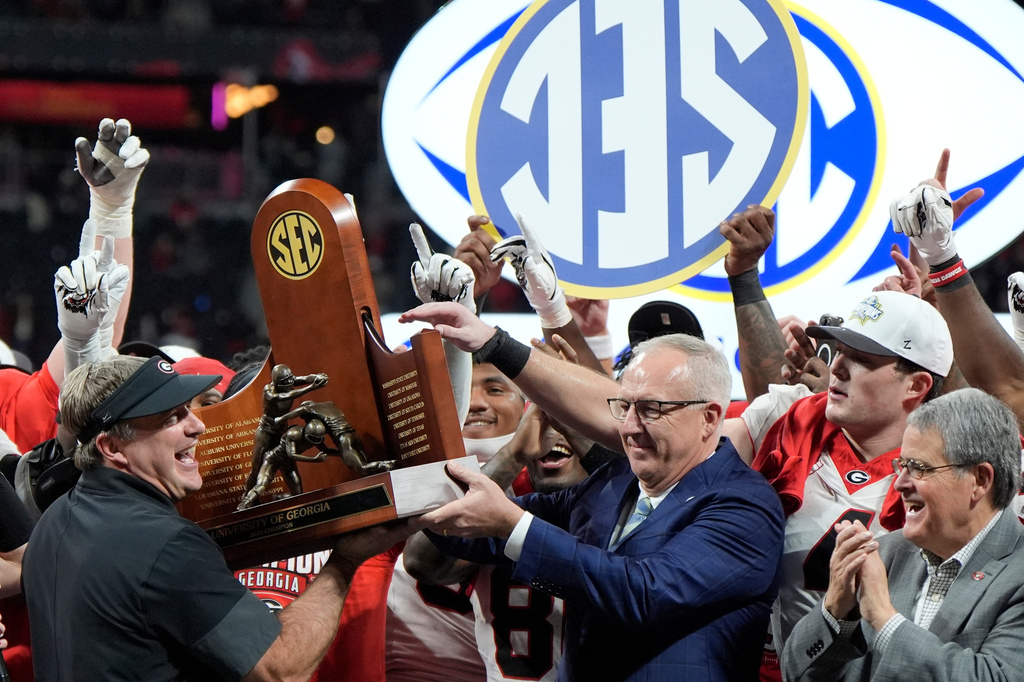 The SEC’s title game is worth in excess of $75 million annually. The ACC, Big 12 and Big Ten editions are believed to be worth another $150 million or so (combined).
If the added inventory (12 games) that would result from a 24-team event doesn’t offset what the conferences would lose — there would be no reason to have championship games — then there’s zero financial reason to expand.
The CFP faces a Dec. 1 deadline to set the field size for the 2027 season. And yet: “We don’t have any idea at this point of clear media interest in an expanded playoff,” Sankey said.
Although weighty, the comment was hardly Sankey’s most memorable remark during the hour-long turn at the podium, which included both the state-of-the-conference address and Q&A with assembled media members.
He did not, in any shape or form, squash speculation that SEC presidents are pondering whether to break away from the NCAA and adopt a self-governing approach that could, in theory, include only intra-SEC competition.
Asked if the breakaway conversations were real, Sankey noted:
“They’re real. People have talked about that. They have opined about the frustrations that bring them to the point of saying we should look at something significantly different. I do not believe that it’s a leverage point. I think that’s honest communication.”
The NCAA “must function in a healthy manner.”
“Otherwise,” he added, “that simmering will continue.”
Whether the simmering eventually morphs into a conflagration depends, to a large extent, on Capitol Hill.
The SEC and Big Ten support many provisions in the Protect College Sports Act, including health-and-safety measures for athletes, agent regulation, limited antitrust protection and uniform eligibility standards.
But the second section of the 111-page bill addresses media rights, terms of conference expansion and the kindling for a super league.
The SEC and Big Ten are adamantly opposed to Congress telling them how to run their business, especially on the topic of membership.
“When I first read (the section),” Sankey noted, “it’s like, ‘Why is that even in there?'”
The fate of the bill, which must reach the Senate floor this summer to have a reasonable chance of passing the House of Representatives, very well could affect how SEC presidents — and perhaps their peers in the Big Ten — view the breakaway option.
And the breakaway option, in turn, could impact CFP expansion.
In college sports, nothing is easy and everything is connected.
*** Send suggestions, comments and tips (confidentiality guaranteed) to wilnerhotline@
*** Follow me on the social media platform X: @WilnerHotline
Related posts:
 Hotline mailbag: Pac-12 leadership, Amazon’s purchasing options, timing for media rights, Utah’s future, WSU’s staff turnover and more

Arizona head coach Adia Barnes (AP Photo/Tony Avelar)
Pac-12 WBB notebook: Stanford falls, Utah rises, Arizona escapes (twice) and Haley Jones takes the pod path
Lauren Betts (AP Photo/Darren Yamashita)
Metcalfe – Pac-12 WBB early forecast: Utah and UCLA are the teams to beat entering the 2023-24 season Big 12 basketball: Houston, Texas Tech, BYU lead our post-NBA Draft deadline power rankings