
 Jon Wilner
Instant reaction to Week 7 developments on the field … and off.
1. Insanity dominates
College football typically delivers at least one week that defies the standard laws of competition. But the sport went above and beyond Saturday, with mayhem from coast to coast and all the way up the national rankings.
Five of the top-seven teams in the Associated Press Top 25 poll lost, a first in the rankings’ history, which began in 1936.
And a sixth narrowly escaped an upset.
Let’s dive in:
Top-ranked Georgia failed to manage its Alabama hangover and lost 27-24 at home to Auburn. So much for the Bulldogs’ 53-game streak against unranked opponents.
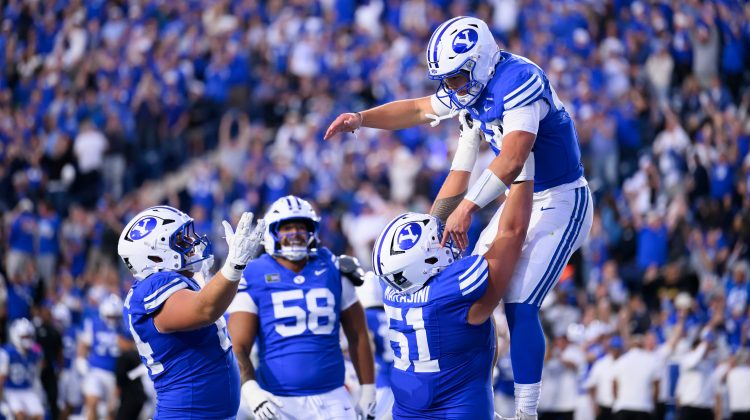
Second-ranked Notre Dame lost at BYU 28-24 when a last-gasp pass by CJ Carr into the end zone fell incomplete. But it shouldn’t have been the final pass, because the Big 12 later disclosed that one second remained on the clock when the game ended. The Irish should have been awarded one more chance from the 8-yard line. Oops!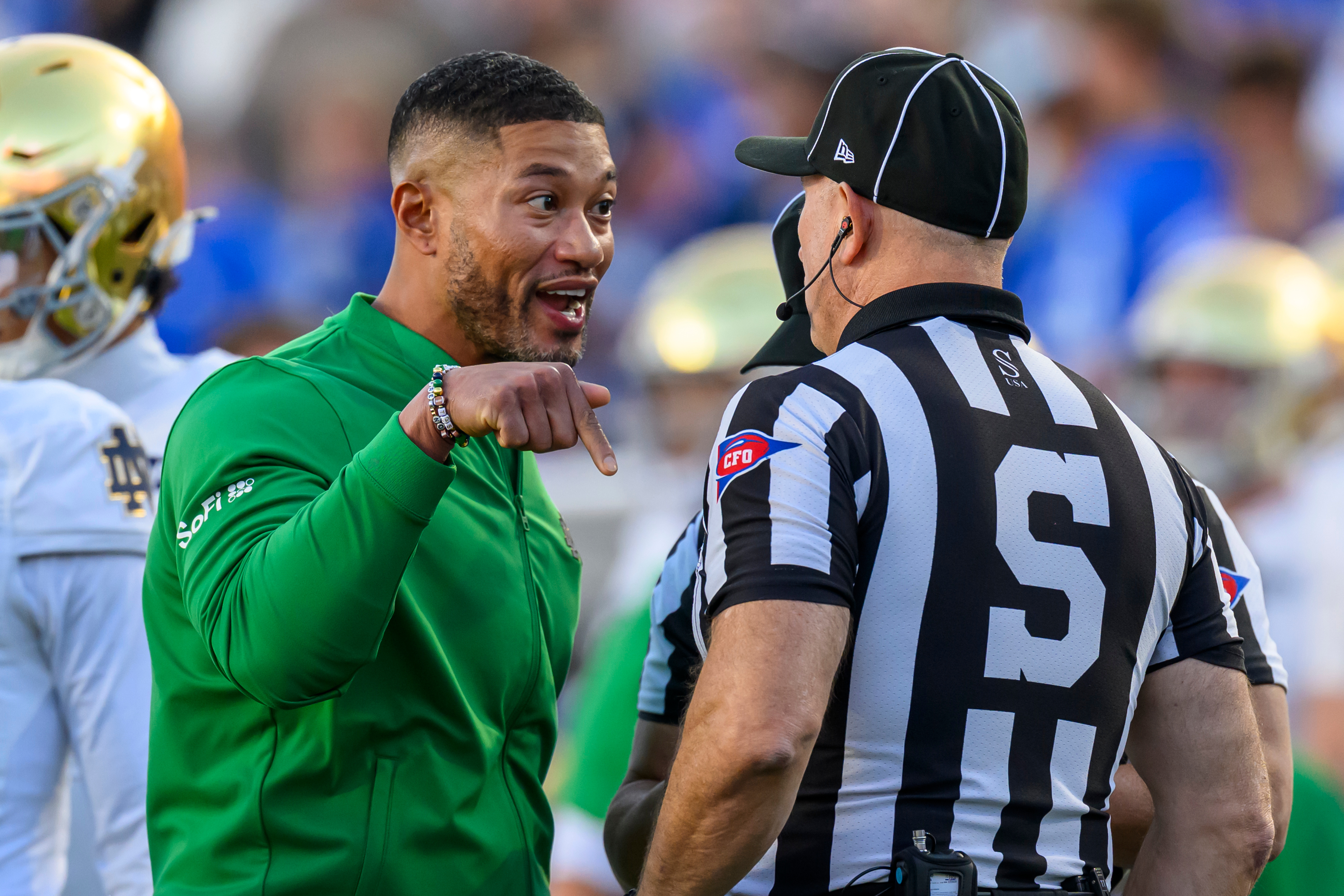
Third-ranked Miami needed double overtime to outlast unranked Florida State 43-35 and had to defend not one but two Hail Mary’s in the process.
Fourth-ranked Ohio State won at Indiana 19-15 but lost quarterback Julian Sayin to an arm injury. Coach Ryan Day said Sayin will be out several weeks, which means he could miss the Buckeyes’ Oct. 31 trip to USC and the Nov. 7 visit from Oregon.
Fifth-ranked Indiana lost to Ohio State when a fourth-down pass into the end zone with one minute remaining was ruled incomplete because half of receiver Nick Marsh’s foot was out of bounds.
Sixth-ranked Alabama failed to overcome a Georgia hangover and was thoroughly beaten at Tennessee 26-10 for its second consecutive defeat.
And seventh-ranked Texas, one week after the gut-punch loss to Oklahoma, was beaten at home by unranked Florida — a result that will assuredly move coach Steve Sarkisian onto the hot seat.
That’s just a snippet of the glorious chaos that unfolded.
Michigan benched quarterback Bryce Underwood, who has a $3 million annual NIL deal with the Wolverines.
UCLA is the only undefeated team in the Big Ten.
The second-best team in the ACC is Wake Forest.
North Carolina doesn’t stink.
Penn State does stink.
The SEC became the first conference since at least 2000 to have five teams ranked in the top 20 lose on the same day.
Oregon State’s offense is incredible.
Oregon’s offense is awful.
And the Big 12 — yes, the Big 12 — claims three of the five remaining undefeated teams in the power conferences. BYU, Utah and Texas Tech are all perfect, along with UCLA and Miami.
Did we mention that five of the top-seven teams lost for the first time ever? Okay, good.
2. BYU to the rescue
The most impactful result, by far, was BYU’s 28-24 victory over the Irish because of the multi-layered implications for the College Football Playoff.
First and foremost, the victory provides the Big 12 with a signature non-conference result that will carry immense value with the CFP selection committee.
Unlike its peers (the ACC, SEC and Big Ten), the Big 12 has not received an at-large invitation to the CFP since the event expanded to 12 teams in 2024.
With the Cougars’ marquee win Saturday night, the conference is well positioned for two bids. Simply put: The committee has proof that the best Big 12 teams can play with national title contenders.
That was not the case the previous two years.
“BYU sent a message to the country,” analyst Kirk Herbstreit said near the end of ABC’s broadcast. “I think it’s a representation of the Big 12. The Big 12 is always looking to find a way to get some credibility or some respect, and BYU carried the flag tonight representing the entire conference.”
There’s another layer to BYU’s win, one that affects all the power conferences.
Thanks to their sweetheart deal with the CFP, the Irish are guaranteed one of the seven at-large spots if they finish top 12 in the final rankings.
At 11-1, they would be a lock.
But at 10-2, it gets dicey.
The loss to BYU pushed them halfway to the brink with Miami looming on the November schedule.
The Cougars not only improved their resume and the Big 12’s position. They also narrowed Notre Dame’s path.
3. The specter of CFP expansion
The Week 7 mayhem unfolded two days after ESPN’s report that ESPN has secured the rights to broadcast an expanded College Football Playoff.
The 24-team event will commence next season, for better or worse.
What was a four-team playoff in 2023 will experience a six-fold increase in just four years, with access as the main driver of change.
The next iteration will include teams with three and even four losses.
To illustrated what that means, let’s consider some scenarios.
The following teams have three losses. They have been eliminated under the current 12-team format but would be very much alive with 24: Arizona State, Illinois, TCU, Washington, Louisville, Virginia, Oklahoma and Texas A&M.
The following teams have two losses. They are in do-or-die mode under the current system but would still have at least one loss to spare with 24: Clemson, Oklahoma State, Kansas State, Minnesota, Oregon, Wisconsin, Nebraska, Michigan, Alabama, Missouri, LSU, Texas and Florida.
Doubling the size of the field offers a Rorschach test for how the sport is viewed.
The Hotline believes the tension created by 12-team CFP is healthy, that it generates incredible weekly drama through September and October.
Those who favor another round of expansion — roughly 35 percent of the power conference teams will be included each year — seemingly want college football to become a mini version of the NFL.
In our view, that is the wrong direction for the sport.
4. Does Washington 2026 equal Arizona 2023?
We could not help but notice backup quarterback Elijah Brown’s impact on Washington’s offense since he replaced injured starter Demond Williams Jr.
The transfer from Stanford has thrown for 553 yards and six touchdowns in roughly six quarters, with the Huskies scoring 59 points in that stretch.
The transformation is reminiscent of Arizona’s evolution in the 2023 season, when backup Noah Fifita replaced the injured Jayden de Laura and the Wildcats shifted to a higher gear.
We are not comparing Brown to Fifita, who is one of the top quarterbacks in the country.
Also, it’s too early to know whether Brown’s impact will come close to matching the effect Fifita had on those Wildcats.
But the situations are linked through Jedd Fisch, who was Arizona’s coach in 2023 and parleyed the Fifita-fueled success into a job offer from Washington after Kalen DeBoer left for Alabama.
Could a ho-hum season for Fisch once again be transformed by an injury to his starting quarterback?
Put another way: Did Fisch go all-in with the wrong player twice, only to have fate intervene both times?
We aren’t ready to render judgment, at least not with Brown.
One month from now, Williams could be back as QB1 for the Huskies, leading them to a strong finish.
But it’s a fascinating subplot to Washington’s season. And Arizona fans are undoubtedly watching it play out with a sense of familiarity.
5. QB woes elsewhere
Washington isn’t the only team that has been derailed by quarterback issues, which we define as either dreadful play or significant injury.
Oregon has struggled to muster a competent offense without injured Dante Moore, who was knocked out of the USC game on a dirty hit.
Washington State coach Kirby Moore seemingly picked the wrong quarterback in Caden Pinnick when he should have turned to Owen Eshelman weeks ago.
Colorado is a mess at quarterback, just as it was last year.
Arizona State benched struggling starter Cutter Boley for Mikey Keene. The move made no difference Saturday in the blowout loss at Texas Tech but could help the Sun Devils find traction down the stretch.
UCLA is without Nico Iamaleava but survived Wisconsin with Ty Dieffenbach.
Cal’s situation is beyond comprehension. Jaron-Keawe Sagapolutele (concussion) was cleared to play this week, but coach Tosh Lupoi opted to start Jackson Brousseau.
The results were predictable: Brousseau was wholly ineffective in a 41-7 loss to Wake Forest (and eventually replaced by Sagapolutele).
It’s hard to quantify how much time and money football programs devote to identifying and signing quarterbacks. And yet there are endless examples of bad evaluations or poor choices with who plays and who sits.
Some of the decisions made by head coaches are, in our view, tantamount to malpractice.
Related posts:
 Brandon Huffman Pac-12 recruiting notebook
 Wilner Mailbag: Next steps for the ‘Pac-2’ schools and a possible reverse merger with the Mountain West
 Huffman on Pac-12 recruiting: Cal and UCLA roll on, Oregon State comes alive and Stanford goes national
 Mailbag: How the 2024 Pac-12 race would have looked, bowl selection criteria, a new ‘Pac’ name and more