
 Jon Wilner
Instant reaction to Week 8 developments …
1. Utter mayhem, part II
The lunacy that erupted Oct. 17, when five of the top-seven teams in the AP rankings lost, continued for a second weekend. And it was glorious.
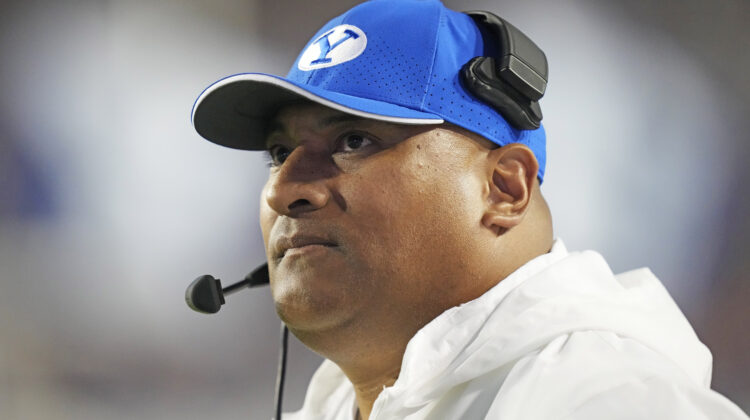
Three undefeated teams tumbled (James Madison, BYU and Texas Tech), which left only three undefeated teams remaining in the entire Football Bowl Subdivision (Miami, Utah and UCLA).
It’s the first time since 1977 that no more than three unbeaten teams were left at this point in the season, according to CBS Sports.
More facts that read like fiction: There have been 11 losses by AP top-10 teams in the past three weeks, which is tied for the highest total in that span in the poll’s 90-year history, per ESPN.
Who’s the best team? We have no clue. None, zero, zip.
It could be No. 1 Miami, but the Hurricanes have played a remarkably soft schedule.
It’s not No. 2 BYU, which lost at unranked UCF.
It could be No. 3 Ohio State, but how will the Buckeyes manage down the stretch without injured quarterback Julian Sayin?
It’s definitely not preseason No. 2 Oregon, No. 5 Texas, No. 8 Texas A&M or No. 10 Oklahoma. They all have multiple losses.
With one Saturday remaining before the release of the first College Football Playoff rankings, the sport has reached unprecedented levels of unpredictability and rollicking good fun.
So naturally, the executives in charge want to change the competitive dynamics of the regular season by doubling the size of the playoff field.
It’s college football, which never found a good thing that couldn’t be messed with.
2. Conference of chaos
The epicenter of the aforementioned mayhem? The Big 12 staked its claim on Saturday, when two of the three undefeated teams tumbled.
Both losses were to unranked opponents.
Both losses were on the road.
One was easy to foresee: BYU’s double-overtime loss at UCF.
One week after their breakthrough victory over Notre Dame, the Cougars were assigned a cross-country trip to face a home team that had two weeks to prepare.
You could spot the loss coming the minute the schedule was released last winter — the trap games of all trap games. The conference did the Cougars no favors whatsoever.
Not for nothing: UCF’s 39-31 victory was one of the most entertaining games of the season, with a sequence at the end of regulation that had to be seen to be believed. (Had the Knights lost, coach Scott Frost would have been tarred and feathered for his decisions.)
The other loss was not as easy to identify in advance: Texas Tech’s face plant at Cincinnati. (The final score was 37-24, but it wasn’t that close.)
The Red Raiders were beaten soundly by a two-loss opponent that rushed for 255 yards, confirming the obvious: They aren’t in the same stratosphere as the edition that rolled through the Big 12 last season.
As the dust settled across the conference late Saturday night, Utah was alone atop the standings with a 4-0 mark (in league play) following its 21-13 victory over Houston.
BYU, Texas Tech, Arizona and Oklahoma State have one conference loss, while five teams have two.
The biggest winner from the weekend, other than Utah? It was probably Arizona, which plastered Iowa State and gained ground in the race for a berth in the conference championship.
The Wildcats visit Texas Tech next weekend, then host Utah in the middle of November.
Don’t be surprised if they are one of the last two teams standing. Their defense is stingy, and quarterback Noah Fifita just might be the best in the conference.
Also, Arizona (6-1) has received far less attention than the Big 12’s other ranked teams. In the upside-down league, it would make perfect sense for a team from the shadows to end up in the spotlight.
3. Elimination day
It’s not even Halloween, and Oregon has been eliminated from the College Football Playoff following a 21-10 loss at Illinois.
We did not have that on our bingo card for the 2026 season.
It wasn’t even listed in the ‘others receiving votes’ category.
At the moment, the Ducks sport the worst return-on-investment in the land: a $40 million roster with three losses, no path into the CFP and an offense that remains incomprehensibly inept.
Sure, quarterback Dante Moore hasn’t played since the near-decapitation at USC — and at this point, we don’t expect to see Moore on the field for the Ducks again. (His return would be heavy on risk and light on reward with the CFP out of reach.)
But the problems in Eugene run far deeper than an injured QB1.
“I don’t know what has to change but I can’t watch this offense anymore,” former Oregon (and NFL) offensive lineman Geoff Schwartz wrote on the social media platform X.
“It’s not that players can’t execute. I mean we aren’t great at QB but we are good enough to have a competent offense. It’s complete sabotage from the play caller.”
That play-caller would be Drew Mehringer, who was promoted last winter by Dan Lanning after his trusted offensive coordinator, Will Stein, left to become Kentucky’s head coach.
Combine bad tactics with an injured quarterback and a wobbly offensive line — then add a defense that’s sturdy but not dominant — and Oregon is a member of the proletariat for the first time in years.
The Ducks spent a lot of money to end up in the Sun Bowl.
4. USC on the brink
Approximately five hours after Oregon took a right cross at Illinois — and just 250 miles away — USC sustained its second defeat of the season: a 24-7 implosion at Wisconsin that looked all too familiar.
“USC seems to have the same issues year after year,” Daniel Jeremiah, the NFL Draft analyst for ESPN and the NFL Network, wrote on X.
He offered a specific list of sins: “1) undisciplined 2) poor OL play 3) bad special teams 4) overall lack of toughness”
And that got us thinking: The Trojans don’t have the same roster every year; they don’t have all the same assistant coaches and coordinators every year; but they do have the same head coach every year.
At least, for now.
If they fail to make the playoff, Lincoln Riley could be cut loose despite a buyout in the $70 million range. And the likelihood of USC snatching an at-large berth is increasingly unlikely.
No team with a 9-3 record (or worse) has qualified for the CFP. If we assume that bar remains in place this fall, the Trojans (6-2) cannot afford another loss.
That task would be daunting under any conditions, but their schedule is particularly rugged with Ohio State at home and Indiana and UCLA on the road.
Put another way:
If the Buckeyes win next weekend in the Coliseum, both USC and Oregon will have been eliminated from the CFP race before the first rankings are released Nov. 3.
Between them, that’s roughly $75 million in player salary.
5. Big Ten gloom
Little has gone right for the conference that claims the past three national championships. In fact, it would have been difficult to sketch a more tumultuous scenario than what has played out for eight weeks.
It’s not the injuries to key quarterbacks (Sayin and Moore).
It’s not the dismal record (4-10) in head-to-head matchups against the ACC, Big 12, SEC and Notre Dame.
It’s not the paucity of teams (four) with fewer than two losses.
It’s not that the teams on the top tier of the standings have spectacularly weak schedules (except Ohio State).
It’s all of it. And more.
The conference has good reason to be concerned about the number of teams with realistic paths into the playoff.
At this point, both the SEC and Big 12 are significantly better positioned.
Related posts:
 Wilner Hotline -Business of Sports: Pac-12 Athletic Departments Close Books on 2021
 Wilner Mailbag: ESPN, Fox and the blue-blood breakaway; MW separation dollars; the future for UW and Oregon and Cal and Stanford
 Mailbag: Kliavkoff’s status, a replacement option, ACC scenarios for Stanford and Cal, Big Ten TV, portal problems and more

(AP Photo/Michael Conroy)
— NFL Combine preview: Quarterbacks Williams, Nix and Penix lead impressive group of Pac-12 prospects