 Jeff Metcalfe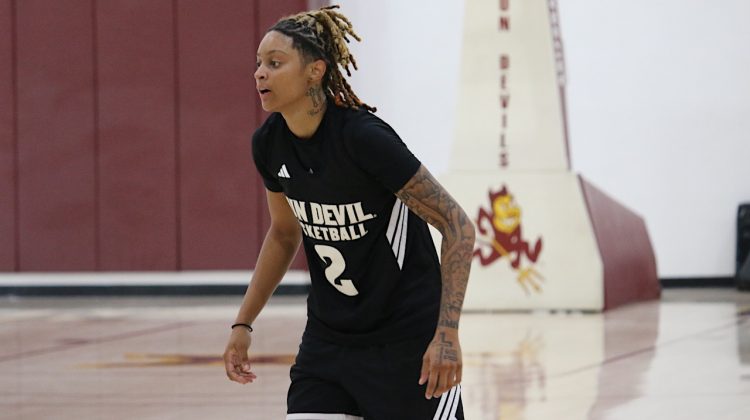
Someone was always going to take a chance on Ruby Whitehorn after her dismissal from the Tennessee women’s basketball team just before the start of last season.
Her three-year production at Clemson and Tennessee was too good not to warrant substantial interest in a 6-foot guard with pro potential.
Whitehorn’s job was to assure schools that her two arrests in three months while at Tennessee were in her past, not her future. And to determine where she could make the most of a fresh start.
“I had some pretty good relationships with a lot of coaches coming out of high school,” Whitehorn says. “It was definitely a few different options to choose from but ultimately it came down to where I felt I was going to be taken care of and loved as a person and not just a player on the court.”
Three-plus months after leaving Tennessee, in mid-February, Whitehorn re-emerged at Arizona State, first as a student ahead of her basketball return in 2026-27.
The more examination of her choice, the more it becomes an obvious one.
Ties with Barber, Elliott
One of Daniel Barber’s early recruiting successes at Clemson was Gabby Elliott, 2020 Michigan Miss Basketball award winner out of Detroit Edison Public School Academy.
When Elliott was a high school senior, Whitehorn was her sophomore teammate. She would win the same Miss Basketball award in 2022 before beginning her college career at Clemson.
“I spent a lot of time in Detroit recruiting both of them,” Barber says. “Their relationship is great and the bond is good between both of them so that obviously made it really easy when I had Gabby there at Clemson to be able to also recruit Ruby.”
Connecting the dots after that requires following the bouncing portal-era ball.
Elliott transferred to Michigan State in fall 2022 when Whitehorn started at Clemson. After just 15 games due to injuries in two seasons at Michigan State, Elliott moved to Penn State, where Barber was assistant coach in 2024-25.
Whitehorn left Clemson, at the same time as Barber, for Tennessee.
Barber joined Molly Miller’s new staff at ASU in 2025-26 with Elliott joining him for her final college season. So Barber and Elliott were in Tempe when Whitehorn began looking for a new home.
“I automatically thought any program that’s got Daniel has got to be an amazing program because he’s a good person, a good coach,” Whitehorn says.
ASU overachieved all expectations in Miller’s first season, finishing 24-11 and making the NCAA Tournament. But with only one guard — sophomore Amaya Williams — returning for 2026-27, that position became a recruiting priority.
No matter how perfect Whitehorn’s basketball fit seemed, Miller needed to judge all facets of her life and put faith in Barber’s deep knowledge about the 22-year-old.
“If we judged everyone on their worst day, that would be tough,” Miller says. “I know Ruby’s got the best heart and she is a good person. For her to be able to understand how she wants to move forward and what that looks like and us talking about that scenario and being on the same page, that to me was this can work here.
“She can finish her career with an amazing opportunity to showcase who she is as a basketball player, as a person, as a teammate, as a community member. I’m excited she’s able to do that here.”
Barber says: “We’ve had no issues with her,” including as a student with a 4.0 grade point average. “This is a kid who truly wants to show her true character. A lot of things that happened, that’s past. We don’t live in the past. Coach Miller always preaches what’s next, what you are going to do, how do you respond to adversity. I feel like she’s responded in a really good way.”
Value of early ASU enrollment
Barber believes that Whitehorn will “bring a new level of scoring and defense that we need on the wing.”
She comes to ASU, albeit for a single season, with arguably the best guard credentials since Briann January (2006-09) and Reili Richardson (2017-20). January went on to play 14 seasons in the WNBA, most for a former Sun Devil.
ASU has not had a WNBA draft pick since Promise Amukamara in 2015.
Whitehorn was a McDonald’s All-America as a high school senior and played on two Michigan state championship teams. In three college seasons, she’s started 90 of 100 games, averaging 11.1 points and 4.8 rebounds. She was ACC All-Freshman at Clemson in 2022-23 and helped Tennessee reach the NCAA Tournament Sweet 16 in 2024-25.
Some early 2027 WNBA mock drafts slot Whitehorn in the second round (No. 16-30 overall). There is room for her to move up if she grows her game at ASU while also proving herself off the court.
Almost everyone becomes a better defender playing for Miller, which would improve Whitehorn’s two-way pro value.
“We’ve worked on her (3-point) shot a lot this summer,” Miller says. “That was something she needed to elevate to be able to play at the next level. We talked about taking the right shots. You can’t sabotage your percentage by taking bad contested shots. It’s not just about volume. It’s about consistency with the right shots.”
Whitehorn is a career 27.8 percent 3-point shooter. Barber thinks she can raise that to 35-40 percent. ASU shot just 29.6 percent overall from 3-point last season, a stat expected to significantly improve via seven incoming guards.
Being at ASU last semester gave Whitehorn time to adapt before being thrust into a key leadership role for 2026-27. She practiced with the Sun Devils and traveled with them to the Big 12 and NCAA tournaments.
“She got a chance to see how the program works,” says Elliott, who led ASU in scoring last season and made All-Big 12 third team. “What type of offense and defense she’s getting herself into to set her up for next season. She was a great person to add to the bench. She brought a lot of energy and personality. It was great to have her.
“You will see a lot of athleticism, big plays, big shots. She does a little bit of everything. She’s going to be rebounding. She does like to get to the rim a lot. I’m just excited to see her out there and the whole team honestly.”
After leaving Tennessee, Whitehorn said on social media that “fear of asking for help” was part of the reason leading to her legal issues. She hasn’t forgotten the importance of that lesson even as excitement grows about her as a player.
“I learned just to speak up if I need help, if I need a shoulder,” she says. “That it’s OK to ask for help sometimes. On the court, off the court, just being able to ask for help is one of the bravest things you can do. That’s going to be my focus point for next year and after that.”