 Sports360AZ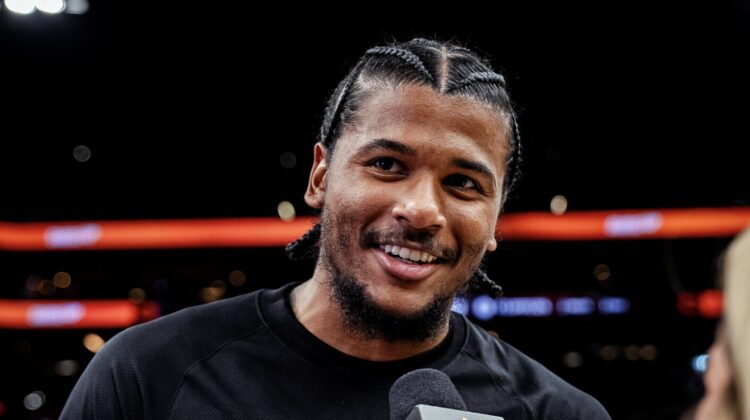
By Gerald Bourguet
The Phoenix Suns will have a new starting lineup this season, and although they have yet to play a single game together, there are justifiable concerns about how well they’ll mesh.
The divisive (and ill-advised) addition of Miles Bridges provides Phoenix with an individual upgrade at the 4-spot, but it cost the Suns two of their three best shooters in Grayson Allen and Royce O’Neale. The starting lineup is still somewhat undersized with both Bridges and Dillon Brooks being 6-foot-7, and flanking Devin Booker with yet another inefficient, score-first co-star feels like a questionable way to build around the face of the franchise.
Brooks had a career year, we didn’t see enough of Jalen Green to get a firm grasp on exactly how he fits, and Bridges is another 20 points-per-game scorer who can occasionally make plays. But none of them is an efficient 3-point shooter or plus playmaker for their position, and there’s reason to question how much pressure the Suns can actually put on the rim with these new additions.
Simply put, surrounding Booker with three guys who should be third or fourth options but will be masquerading as second options on a night-to-night basis — and doing so inefficiently — will almost certainly pigeonhole the Suns’ best player into more of a facilitator, “Point Book” role, rather than optimizing him with a more appropriate balance between “off-ball killer” and “on-ball initiator.”
In fairness, anything is possible in this league, and we’ve seen plenty of players meaningfully improve or adapt their games for the good of their teams. While it’s hard to see any of these guys suddenly becoming 3-point snipers or changing in seismic ways, it may be possible for this starting lineup to come together with a few important tweaks.
To that end, and barring acts of God or on-court miracles, we’re continuing our weekly series that examines all five members of the Suns’ projected starting lineup with the goal of pinpointing one specific area where each player must improve in order to make this work.
Last week, we took a look at Devin Booker’s pull-up 3 being the final missing piece in his game. This week, we’re diving into the need for Jalen Green to put more pressure on the rim.
Why we chose “rim pressure” for Jalen Green
In all honesty, there were several areas to choose from with Jalen Green’s game: rim pressure, shot selection, 3-point efficiency, playmaking, and a more efficient midrange game. No disrespect to Green, but any one of those would’ve been a valid response to this prompt.
With that being said, it’s difficult to envision him drastically altering most of those areas of his game. On the 3-point front, he’s a career 33.9 percent shooter from deep, and he shot just 31.3 percent from downtown last year. Two years ago, his 35.4 percent shooting from beyond the arc became his career high, marking the only time in five NBA seasons where he’s reached the 35 percent threshold.
Given that, his high volume of 7.4 attempts per game, and the aggression (or rather, audacity) of his pull-up 3s, it’d feel like wishful thinking to expect his 3-point percentage to land in the high 30s or low 40s, where Phoenix would like it to be. A guy who regularly takes more pull-up 3s than catch-and-shoot triples — and only made 29.8 percent of those pull-up 3s last year — probably isn’t going to turn things around over the course of one full season.
Likewise, “shot selection” or “a more efficient midrange game” might have made sense, but it’s hard to see either of those changing in meaningful ways when the Suns have been so high on Green and what he brings to the table. If Booker is going to have to function as this team’s lead initiator and playmaker, that means guys like Green, Brooks and Bridges will need to be in attack mode.
And with that, comes Green’s questionable shot selection. Remember, this is a guy who, in his last full season in Houston, posted the worst midrange field goal percentage among the top 50 players in attempts that year. He was among the worst isolation scorers in the league as well, ranking 50th in points per possession among 52 players who got a minimum of 250 iso plays. All that, despite ranking ninth in the league in midrange field goal attempts that year.
Green has never seen a pull-up or step-back middy that he didn’t like. The Suns just kind of have to make their peace with that, and truthfully, “shot selection” is the main area for another Phoenix starter to work on (which we’ll cover in the coming weeks).
“Playmaking” was probably the hardest one to rule out, but again, a zebra can’t be expected to change its stripes. Green only averaged 2.8 assists per game last year, and while his season was obviously broken up by hamstring injuries, he’s only averaged 3.3 assists per game for his career.
Green racked up nearly as many turnovers (72) as assists (91) last year, and his assist-to-usage ratio ranked in the 29th percentile among wings. Out of the 35 players who attempted at least 16 field goal attempts per game last season, Green ranked 31st in assists and 26th in assist percentage. The year prior, while Book was leading the NBA in 3-point assist generation, Green ranked dead last in assist percentage among all players who took at least 17 field goals per game.
Why on earth would the Suns take the ball out of Book’s hands to make a significantly worse playmaker their “point guard”? Even if they decided to go with conventional positional designations that don’t really exist anymore, and even if they had Green dribble the ball across half-court every time like a traditional point guard, Booker would still be initiating everything in the half-court.
Because of all that, and because rim pressure is a more snug fit with Green’s actual skill-set and physical attributes, we’re going to hone in on Green’s ability to get to the basket and finish — and why he needs to do it more often and more efficiently.
The Suns need Jalen Green to provide rim pressure
The obvious starting point in all this is Jalen Green needs to stay healthy enough to actually find his groove with this new starting five. There’s still plenty of reason to doubt his fit with this group, but it’s also fair to say that missing 50 games with hammy injuries prevented him from ever building a sustainable rhythm or chemistry with his new teammates in Phoenix.
Beyond that, though, the Suns need Green to be more of the consistent downhill threat he was billed to be when Phoenix initially got him in the Kevin Durant trade.
“I mentioned it after the draft, we did not attack the rim very well last year,” general manager Brian Gregory said at the time. “It’s an area we have to get better at. You do it three specific ways: on the drive, on the cut, a big man getting the ball in the post area, which doesn’t happen all that often anymore. And then the effort way you do it is on the offensive glass. I think Jalen on those first two is gonna be really, really good.”
Unfortunately, the numbers at the time didn’t really bear that out, nor did we see anything in 2025-26 to really change anyone’s opinion on that front.
In 2024-25, Devin Booker ranked 11th in the league in drives, 16th in assist percentage on drives and fourth in assist-to-pass percentage, while Green ranked 38th in drives, 48th in assist percentage on drives and 205th in assist-to-pass percentage. Last year, Booker and Green ranked 70th and 71st in assist percentage on drives among all players who tallied at least 300 drives, but Booker recorded the fifth-most drives in the NBA, while Green ranked 39th.
In other words, there’s a pretty big gap between the two in terms of putting pressure on the paint. Green often dribbled himself into trouble, which is why his drives also came with a high turnover rate:
So in terms of getting into the paint with the ball in his hands, Green has a lot of ground to cover. That’s not the end of the world, since Booker’s drives help set the table for everyone else due to his superior gravity and playmaking, but it puts more emphasis on the cutting side of things if Phoenix wants Green to get to the rim.
Unfortunately, Green has been very middle-of-the-pack on the cutting front. In his last healthy season in Houston, he only ranked in the 55th percentile in cuts per 75 possessions with a mere 1.7 percent frequency, and he placed in the league’s 47th percentile in points per possession on those plays. Last season, he only bumped up his cut frequency to 2.1 percent, and dropped to the 20th percentile in points per possession on those cuts.
It’s a shame, because Phoenix needs people who can put pressure on the rim, and Green’s combination of lightning speed and dynamic leaping ability should make him a natural fit, especially as a second option who can attack closeouts or feast on backdoor cuts like the ones he got in Houston:
Cutting should be right up his alley, especially since it was a point of emphasis for Jordan Ott going all the way back to his introductory press conference. Both he and the Suns need to find a way to work that type of off-ball threat into this year’s offense more, especially with yet another ball-dominant scorer entering the starting lineup.
But whether it’s by drives or cuts, Green needs to get to the rim more often, and he needs to be a lot more efficient when he does. As a reminder, the Suns have ranked 28th, 30th, 25th, 30th, 30th and 30th in the league in rim frequency over the last six years, so having this type of athletic speedster is just begging for his aid to finally get Phoenix out of the bottom-five.
Green has historically never been a great finisher at the rim, but over the last two years in Houston, he was at least middle-of-the-pack among guards. In his final season with the Rockets, Green placed in the 54th percentile in rim frequency and the 53rd percentile in rim accuracy. Last year in Phoenix, he stayed relatively level in rim frequency (56th percentile), but plummeted in accuracy (25th percentile).
Part of that drop-off had to do with the injuries and trying to find his place in a new system. It was clear his hamstrings — and learning to trust them again as he worked his way back from rehab — robbed Green of some of his trademark burst, which was evident when he turned the corner or tried to elevate:
But it’s worth mentioning that Green hasn’t been an above-average finisher since his rookie year, when he ranked in the 73rd percentile in rim accuracy. In the four years since then, he’s dropped to the 20th, 53rd, 53rd and 25th percentile among wings in that category.
That’s simply not good enough, and once again, shot selection plays a part. The Bball Index has ranked Green in the NBA’s ninth and seventh percentile in “rim shot quality” over the last two years, so even though he can create his own looks and get to the basket, he doesn’t do it often enough, and when he does, the results have underwhelmed.
As fun as the gravity-defying, blink-and-you-missed-it, rim-rocking dunks can be, Jalen Green is a subpar finisher when he doesn’t have a clear runway to the hoop. He shot 54-for-66 on dunks in his final Rockets season, converting at an impressive 81.8 percent, but the volume and efficiency of those memorable finishes paled in comparison to the 215-for-406 that he shot on layups, which was only 53.1 percent.
Last year in Phoenix, Green saw the first number free-fall to 59.1 percent shooting on only 22 dunk attempts, while he stayed relatively level on layups, converting 53.8 percent of his 143 attempts.
For all the high-flying slams and gorgeous midair maneuvers slicing through the air, Green has a tendency of attempting some ludicrous layups, which defenses are all too happy to return to sender…or simply watch as they fall off the rim after a contest:
Despite all the numbers and film to this point suggesting that Jalen Green tops out as a mediocre rim finisher, there isreason for hope. As we mentioned, injuries deprived him of finding his full footing in Phoenix. Playing next to someone like Devin Booker should open up more driving and cutting lanes once he gets fully acclimated to this new starting lineup, and barring injury, Suns fans should see more of his exceptional athleticism this year.
Even last season, it was clear when Green figuratively turned the corner on those hamstring injuries, because the burst was evident when he literally turned the corner and was able to elevate and finish:
We should also note that Green was a monster in transition in his last healthy season, ranking in the 91st percentile in both transition shot creation and transition shot-making. Give this demon a full head of steam in the half-court or on the break, and he’ll rack up some highlights:
“Well, I think we’ll be really fast!” Brian Gregory said last summer after Phoenix acquired Green. “You know what I mean? The game is played at a faster pace, and the ability to attack and get downhill is something he does exceptionally well.”
It’s on the Suns, then, to figure out how to harness Jalen Green’s positive attributes and shy away from the more inefficient ones. That starts and ends with placing more emphasis on rim pressure through drives attacking closeouts, off-ball cuts, and pushing the tempo in transition.
Utilizing a player like this will always come with certain hurdles, but if Ott can learn how to walk this tightrope act with a new starting five that demands nearly perfect balance, Jalen Green can be a legitimate weapon. Though he’s never been a super efficient finisher, in the right context, he can be better than he’s shown. It’ll be on the Suns to empower and unleash this lightning-quick, downhill force, while tweaking his shot selection…all without taking away his freedom or confidence.
For more of Gerald Bourguet’s Suns work, check back with Sports360AZ on a weekly basis, subscribe to his Patreon articles and podcast at Suns After Dark, or follow him on Twitter.