 Sports360AZ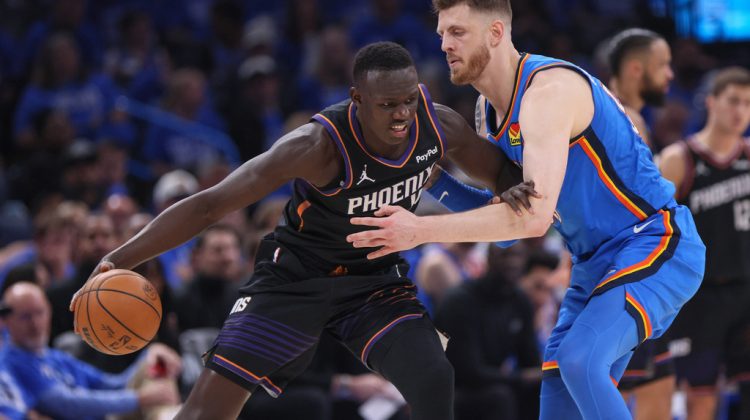
By Gerald Bourguet
Over the last four weeks here on Sports360AZ, we started a series pinpointing one specific area where each Phoenix Suns starter needed to improve in order to make the starting lineup work.
We had taken a look at Devin Booker’s pull-up 3 being the final missing piece in his game; the need for Jalen Green to supply more rim pressure; Dillon Brooks’ shot selection/tunnel vision; and Miles Bridges’ secondary playmaking. This week, it was supposed to be Mark Williams’ turn.
Unfortunately, Williams suffered a torn labrum in his left shoulder, and while there’s no official timetable for his return, Arizona Sports’ John Gambadoro reported that this injury will likely sideline him for at least five months.
Losing the team’s starting center until at least mid-February derails the final chapter of our five-part series, but it obviously will have much larger ripple effects on the Suns themselves. Namely, who will be Phoenix’s new starting center for the upcoming season?
To answer that question, we’ll be pivoting to a new two-part series where we examine the cases for both Khaman Maluach and Oso Ighodaro. Should the Suns go with more established (albeit undersized) big in Ighodaro? Or should they kickstart the future by handing the keys over to their recent top-10 pick in Maluach?
We’ll make the argument for Ighodaro next week, but today, we’re going to present the strongest case possible for Khaman Maluach to get the starting nod on opening night.
The case for Khaman Maluach to start
The first thing that leaps off the page is the size discrepancy between Maluach and Ighodaro. Man Man is 7-foot-2 with a near 7-foot-7 wingspan. Ighdaro, meanwhile, is 6-foot-11 with a 6-foot-11 wingspan. That difference in size and length matters when you’re talking about playing starter’s minutes at the 5, and it manifests itself in several key areas.
Rim protection is the first one. In just 8.9 minutes per game last year, Maluach (0.7 blocks per game) averaged as many blocks as Ighodaro (0.7) and nearly as many as Mark Williams (0.9). That’s probably more an indictment of the other two bigs, who were nearly three times as many minutes, but Maluach’s shot-blocking numbers were on another level for a rookie.
On a per-36-minutes basis, Maluach averaged 2.9 blocks, which more than doubled Williams (1.4) and Ighodaro (1.1). His 4.0 block percentage ranked in the 96th percentile among NBA bigs, while Ighodaro’s 1.7 block percentage ranked in the 54th percentile.
Furthermore, opponents shot 19.8 percent worse than they’d normally shoot at the rim whenever Man Man was contesting. That mark blew Ighodaro (5.1 percent worse) and Williams (0.1 percent better) out of the water. In fairness, Ighodaro (353) and Williams (357) defended more than three times as many rim attempts as Maluach (106), but a -19.8 percent mark in rim defensive field goal percentage is pretty eye-opening!
Every advanced metric on The BBall Index painted Maluach as an elite rim protector and shot blocker too:
- 96th percentile in rim protection
- 99th percentile in rim disruption
- 99th percentile in help defense talent
If you’re not into all these nerdy numbers, the eye test popped as well. Whenever Maluach was on the floor, especially late in the season when he got consistent minutes, he showcased the type of weak-side shot-blocking that neither Ighodaro nor Williams are capable of providing:
The instincts, reaction time and absurd length to reach shots at the apex can’t really be taught. Maluach just has the physical tools to be something fearsome in that respect, especially once he gets his feet wet and feels more comfortable playing heavier minutes.
He’s obviously nowhere near as mobile as Ighodaro when it comes to defending on an island, and we should note that Maluach only ranked in the NBA’s 12th percentile in perimeter isolation defense, per The BBall Index.
But there were enough flashes to believe this 20-year-old can improve when it comes to holding his own on an island. He’ll never be a fully switchable big like Ighodaro, but these on-ball and chase-down blocks provide some hope he’ll be able to recover whenever he does get beat:
Aside from rim protection, Malauch’s superior size and length gives him an advantage on the boards as well. Man Man ranked in the 93rd percentile in offensive rebounds per 75 possessions and the 91st percentile in defensive rebounds per 75 possessions. Ighodaro, by comparison, ranked in the 80th and 74th percentile in those respective categories.
Maluach was a demon on the offensive glass as a rookie, and the Suns were likely pleased to see how dominant he was on the boards over the summer in Las Vegas, where he recorded a double-double in all four games and led all Summer League players in rebounding average. For a team that struggled to close out defensive stops with a rebound last year, having a 7-footer who can theoretically help with that must be appealing.
The Suns will also be hoping the 3-point shot that Maluach showcased in Vegas translates to Year 2 in the NBA. Watching Man Man shoot 8-for-20 from downtown was one of the biggest Suns takeaways from Summer League, and if that 3-ball is legitimately ready for the NBA level, it’s a transformative skill that could really open things up for this team’s spacing.
Remember, this is the rest of the Suns’ starting lineup, so even if Maluach just shoots 35-36 percent from 3 on a few attempts per game, that would really provide a level of spacing and 3-point efficiency that neither Ighodaro nor Williams can bring to the table:
- Devin Booker: 35.2% from 3 for his career, 33.0% last year
- Jalen Green: 33.9% from 3 for his career, 31.3% last year
- Dillon Brooks: 35.3% from 3 for his career, 34.4% last year
- Miles Bridges: 33.8% from 3 for his career, 33.3% last year
Even as a rookie, Maluach’s 5-for-21 mark from deep still blew the competition out of the water, since Ighodaro went 0-for-3 over the first two years of his NBA career. It sounds crazy to say out loud, but it’s not outlandish to wonder if Maluach might be one of the Suns’ top-five 3-point shooters this season in terms of efficiency!
Free-throw shooting is another area where Maluach holds a definitive advantage. Man Man made 71 percent of his free throws as a rookie, and while that still leaves room for improvement as he gains more confidence and reps with his shot, it’s a much better starting point than the 45.3 percent Ighodaro shot from the line last year (or the 49.1 percent that Oso’s shot from the charity stripe thus far in his career).
Finally, as much as Ighodaro is an underrated rim finisher who actually shot a much better percentage at the basket last year than Maluach, Man Man has the physical tools to be downright elite on that front. He pretty clearly still needs to get stronger and more confident around the basket (remember that wonky shot he banked in against Yang Hansen at Summer League, and how he couldn’t back him down on the block?).
But as he puts on more NBA muscle and gets used to banging bodies in the post on a nightly basis, he’ll become the type of rim runner who has actual gravity and can finish plays above the rim. Ighodaro can be an alley-oop target with a clear runway and a full head of steam, but Maluach’s size and long arms will make him a more natural lob target for Devin Booker and the Suns’ ball-handlers, even when he’s diving in traffic.
Finally, there’s an argument to be made that Maluach should be the starter simply because he represents the future of the center spot for Phoenix. They drafted him 10th overall in 2025, there was internal belief he would’ve overtaken Mark Williams as the starter by the end of the upcoming season before Williams got hurt, and throwing Maluach into the fire in Year 2 — after taking a painfully patient approach to his development in Year 1 — might be just the thing he needs to take flight.
Ighodaro might be the more NBA-ready option, but Maluach is more of a traditional big who can block shots at the rim, dominate the glass and provide a rim-running target in the pick-and-roll. That skill-set may be what the starters need, and being able to play off Phoenix’s best players would probably be better for his development.
Ighodaro will be able to function whether he’s starting or coming off the bench, and the latter feels more like his ultimate destiny in the NBA. His synergy with Collin Gillespie (and Luke Kennard) would make the Suns’ second unit even more formidable, and it might give Phoenix’s lineups a little more balance.
Both these bigs are going to play ample minutes, and some nights, Jordan Ott may have to lean more heavily on one than the other, depending on the matchup. But if Khaman Maluach proves himself in training camp, why wait any longer to kickstart the future?
The case against Khaman Maluach starting
There are some potential drawbacks to starting Maluach, however. First off, he just turned 20 years old and played a grand total of 411 minutes over 46 games as a rookie. Despite how dominant he looked at Summer League, we always have to take Summer League with a grain of salt. There’s a chance he’s simply not ready for this challenge.
Even if Maluach is somewhat ready to make the leap from “seldom-used developmental rookie” to “full-time starting center,” there are some areas of the game where Ighodaro might just be a better fit for the starting lineup.
Ighodaro screens with pace and precision, and he’s capable of making the right pass out of the ensuing short roll when the Suns’ ball-handler (usually Devin Booker) is blitzed or double-teamed. Maluach, meanwhile, doesn’t bring any sort of secondary playmaking — or even rudimentary passing — to the table right now.
As a rookie, Man Man’s 1.9 assist percentage ranked in the zero percentile among NBA bigs, and his assist-to-usage percentage ranked in the first percentile. That’s a virtually non-existent level of passing, and that flaw was still present at Summer League. He also struggled with his handle, including simple actions like dribble-handoffs or dribbling the ball from one side at the top of the key to the other without getting bumped off his line or turning it over.
Maluach’s turnover percentage as a rookie ranked in the 16th percentile among NBA bigs, and despite how good of a shot-blocker he was, he wasn’t getting many of those turnovers back with steals or deflections. That’s probably one of the bigger areas for improvement in his game, since his 0.4 steal percentage (third percentile among bigs) was dwarfed by Ighodaro’s 1.8 steal percentage (87th percentile).
Rim finishing is probably the biggest area for improvement, though, since Maluach only converted 64.4 percent of his shots at the rim. That number drops to 60 percent if you exclude garbage time (which seems somewhat unfair, since so many of Maluach’s minutes came in garbage time).
Finally, there’s a chance Maluach just isn’t as good at defending pick-and-rolls in Year 2 as Ighodaro was last year, let alone how good Ighodaro will be heading into Year 3. According to The BBall Index, Maluach ranked in the 51st percentile in screener mobile defense and the 40th percentile in screener rim defense, while Ighodaro placed in the 98th and 97th percentile in those respective categories.
Because Maluach is younger, less experienced and not quite as mobile, opponents will target him with multiple actions, constant pick-and-rolls and switches to get him on an island. The damage will be greater against opposing starters, and Maluach may not be able to hold up against all that targeting like Ighodaro can. This sort of weakness could quickly negate whatever advantages Man Man brings as a shot-blocker and rebounder.
All in all, there are major pros and cons when it comes to starting Khaman Maluach. He’ll be one of the Suns’ most vital pieces either way, as will the perpetually underrated Oso Ighodaro, but all of these potential strengths and weaknesses have to be considered before Jordan Ott makes his final decision on how to replace Mark Williams in the starting five.
For more of Gerald Bourguet’s Suns work, check back with Sports360AZ on a weekly basis, subscribe to his Patreon articles and podcast at Suns After Dark, or follow him on Twitter.