 Sports360AZ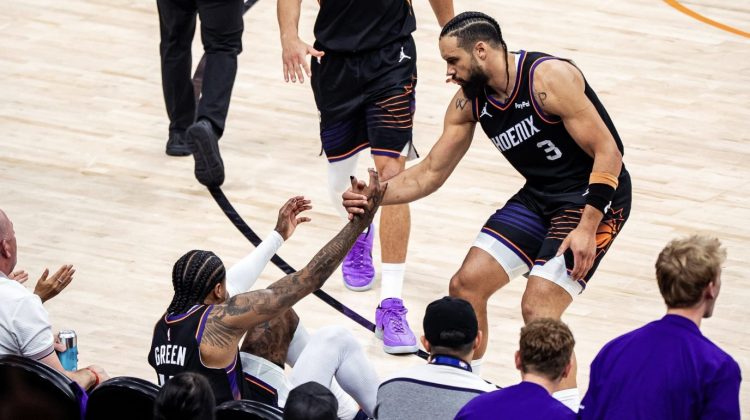
By Gerald Bourguet
Love him or hate him, but in the vivid and diverse tapestry that is the NBA, Dillon Brooks is undeniably one of its most colorful characters.
His “Villain” schtick might wear on whichever opposing fanbase has to stomach his antics, his trash talk, his mean mugs, his physical defense or his tough shot-making for the night. But for his current team — and the teams that have enjoyed his time with their franchise in the past — Brooks is more complicated than just pure villainy.
That’s even truer after Brooks’ first season with the Phoenix Suns. The 30-year-old enjoyed a career year last season, averaging 20.2 points per game while helping lead the Suns to the playoffs. Phoenix exceeded all pre-season expectations, and Brooks helped re-establish the team’s culture, pride and grittiness on both ends of the floor.
His tangible impact on and off the court earned him a three-year, $73 million extension that will keep him in the Valley through the 2029-30 campaign, so Suns fans have four more years of villainous work to look forward to now.
Granted, there are undeniable downsides to entrusting so much to a self-proclaimed Villain. We’ve written about the duality of Dillon Brooks before, and it remains true that his notorious tunnel vision, brutally difficult shot selection and penchant for giving opponents fuel with his whole Villain routine can all backfire…and that’s before you mention how he led the league in technical fouls last year.
Reputation techs or not (and many of them were reputation-based), a team can only be so good if Dillon Brooks is their second- or third-best player. As impactful as he was in each of his last two NBA stops, the Memphis Grizzlies and Houston Rockets learned this the hard way, repeatedly banging their heads on the same playoff ceiling while Brooks was a key part of their starting lineup.
But there’s something to be said of what those teams became after he left, with many of them yearning for the dichotomous nature of his NBA persona.
In Chinese philosophy, there is the concept of “yin and yang,” where two cosmic forces oppose and complement each other at the same time. When they interact, they support and perpetuate the other, forming a system where the whole is greater than the sum of its parts. Distinctions between “good” and “bad” come down to perception, but they aren’t real, which makes yin and yang indivisible as a whole. In other words, you cannot have one without the other.
Dillon Brooks may be the closest thing the NBA has to a living embodiment of yin and yang, and it’s an identity he’s embraced for a while now.
“As a human being, you have good, and you have a little bit of bad, a little bit of villainy,” Brooks told The Athletic’s Doug Haller. “It’s always in moderation, but I feel like people kind of resonate with that. A villain doesn’t have to be always bad. There’s good in it, as well. It’s the hard work. It’s the relentlessness to be the best at what you want to be, and I try to instill that in myself and try to showcase it in a different way.”
So as much as the Villain “is who he is” to a certain extent, that doesn’t mean he’s incapable of positive growth. That may be part of the reason Brooks went to China this summer, where he not only learned some kung fu and trained with UFC fighter Li Jingliang in the Wudang Mountains, but also learned about taoism, a philosophical and religious Chinese tradition.
So what did he take from that type of unforgettable whirlwind of a trip that he can now implement into the NBA?
“If anybody pisses me off, I’ll give ‘em a dropkick,” Brooks said with a smirk at Media Day. “Especially the ones that are wearing stripes.”
Classic Dillon Brooks! Fortunately, he had more to add on a more serious note.
“No, I learned the opposite of that,” he said. “I learned how to center myself, simplify my life and focus on what I need to focus on. I learned a little way of life, it’s called taoism. Synergy. They call it the pure way of living, simple living.”
For the uninitiated, taoism emphasizes living in harmony with the “Way,” which is the natural order of the universe from which all things originate and flow. It places values on the “three treasures,” which are the virtues of compassion, humility and frugality; it abides by the practice of “Wu Wei,” a flow state of effortless action that moves with the flow of the universe rather than force outcomes; and of course, it embraces the concept of yin and yang.
The dichotomous nature of getting an entire fanbase to root for the “villain” of the story fits Brooks to a tee, but compassion and humility for a guy who’s made a career out of pissing people off? Frugality as an NBA player? Notforcing the outcome with that shot selection? We love a more centered king, but those things decidedly don’t sound like Dillon Brooks.
In fairness, he’s fully aware that it might be challenging to implement what he learned into his NBA lifestyle.
“It’s gonna be a little bit tough with all these cameras and all these people and going state to state and playing basketball games,” Brooks admitted. “But I can take a little bit and center myself in the hotel rooms or getting ready for games, staying focused. So those are the things I kinda take from it and put it into the Villain.”
And who’s to say he won’t? Even if he’s still the same fiery competitor once he steps in between the lines, perhaps these new lessons can reduce the instances where Brooks forces the issue?
“I think the centering-ness of going through different movements, like when I’m working on the court, is gonna get me to be more still and focused and motivated to do what I did last year, [which] is to dominate every game and be able to use my voice in the right ways,” Brooks told NBA TV. “So, no more technicals!”
Granted, he broke out into laughter immediately after saying that, so even Brooks knows going cold turkey on techs probably isn’t realistic. The Suns wouldn’t want him to lose his edge either. But even cutting down on some of the technical fouls would help, because Brooks would then become an overwhelming net positive, given everything he does for this team off the court.
That underrated aspect was a major contributing factor in the Suns’ decision to extend Brooks through his age-34 season. His play will undoubtedly have fallen off a bit by the tail end of his contract, but as one source told Suns After Dark back in May, “leadership and toughness doesn’t age.” Phoenix values those locker room attributes, which Brooks understands are among his strongest suits — and most important responsibilities.
“To be the leader, to be the person who connects everybody together,” Brooks said. “My job is always to man the defense and be able to get guys to put effort into the defensive end….It’s just setting the tone each and every night. It doesn’t matter who we’re playing, if we’re playing the worst team or the best team, it’s setting that tone every night. If I feel like the guys are tired after a long road trip or a back-to-back’s coming, I’ve gotta set the tone to get that energy going.”
For all the emphasis on “setting the tone” or “playing with a chip on his shoulder,” chalking it up to just that would be a disservice. Just as he did in Houston and even Memphis, Brooks has had an immeasurable impact on his Suns teammates, especially the youngsters.
Last year, Brooks was on Oso Ighodaro’s case, constantly trying to get under the sophomore’s skin for months on end. In December, Ighodaro snapped back at the veteran.
Brooks’ response? Finally.
Oso Ighodaro apparently snapped at Dillon Brooks during the game.
Brooks: “Finally he yelled at me. Finally. Been waiting for that, been getting under his skin for about 3 months. Finally he exploded.”
Did Brooks ask or force that out of him?
“I asked to begin with. But…”
— Kellan Olson (@KellanOlson) December 19, 2025
At training camp this week, Brooks admitted he’s set his sights on rookie Koa Peat next, joking that “he’s a little shy though, I gotta break that wall.” When Ighodaro was asked whether he had any advice for Peat after going through the same mentorship last season, he cracked a grin.
“Just to go at him,” Ighodaro said. “He thinks he’s big and bad, okay. Like, I’ll go right back at you! But I don’t know, that head-to-head, I love it. It gets us better. Now a year [in] with Dillon, I know how he operates, I know how to get under his skin a little bit, so I can get back at him.”
In the moment, Brooks’ abrasive “welcome to the NBA” approach probably feels like a lot for a first- or second-year player. Jalen Green experienced it in Houston firsthand as well.
“DB has an interesting way of showing he cares, especially for a rookie,” Green said with a smile. “I can speak to it just ‘cause he came from Memphis, a winning team, to Houston and did the same thing with me. So yeah, me and him have a good relationship now over the time. But yeah, he has a different way of showing it. I think it’s going to be very helpful for Koa. It was helpful for Oso. DB’s a great leader, and he knows the game well.”
Now, Green refers to Brooks as being “like a real brother”…even if he’ll never forget the time his vet ripped into him.
“Like, I understood what he was trying to get out of me, but I think it was more him, like, yelling on the court one time, like screaming at me, and I was like, ‘All right, bruh,'” Green said, laughing. “You know what I’m saying? But that goes with it though.”
Green and Ighodaro aren’t isolated cases either. Pretty much every player who’s ever been Brooks’ teammate speaks glowingly about him, both in Phoenix and throughout the league.
“His approach, the way he works, I knew, like — he was great in Memphis, he’s great now, and he just continues to get better,” said Luke Kennard, a former Grizzlies teammate. “That kind of behind-the-scenes stuff, I’ve gotten to know him, he’s a great, great person, great leader, great teammate. And when he steps on that floor, he’s a competitor, and he works on his game, works on his craft, and it’s exciting to be a part of that and see that.”
“I ask him questions all the time,” Ighodaro added. “We have our back-and-forth and our banter like we just had, but we have serious conversations about the game, about development, and it’s really helpful having a leader like that.”
Maybe that type of impact isn’t “compassion,” per se, but it’s in the neighborhood. As for humility, Brooks’ humble beginnings make it no surprise that he’s so willing to put the team first and mentor the youngsters with his own brand of tough love.
In fact, Brooks would even say his passion and drive are byproducts of his more humble beginnings.
“I guess not being recognized the way I wanted to be, which, that was from a young age,” Brooks said. “And I’m glad that nobody looked at me as a phenom or a superstar or someone that’s so great, or else I might not have that fire or that passion that I bring to the game. And now it’s like an addiction. It’s like something that’s just part of my routine that you can’t get rid of. It’s hard to change, and I don’t ever wanna change it.”
“Like I always say in other interviews, that comes from my dad’s side from Nova Scotia, being in the country, always trying to fit in with those guys coming from the city. I never wanted to be a pretty boy or anything like that. I like to be the hard-nosed, rough-around-the-edges guy. So I took on that, and that’s why I am who I am.”
From his early days playing the game, Brooks wasn’t some highly touted, hyped-up prospect. He’s used to having to outwork his opponents, out-grind the competition, and get under people’s skin to let his game shine. It comes with the Villain territory, and it’ll be interesting to see whether he can actually implement the taoist principles he learned into his nightly approach once he steps onto the court again.
But it wouldn’t be Dillon Brooks if he didn’t try to channel conflicting ideologies into something that could ultimately help his team. True change is hard, and neither the Suns nor Brooks should want him to change too much; embodying both the yin and the yang, the flow state and the forced outcomes, the Villain and the Taoist, is what makes him so special in the first place.
For more of Gerald Bourguet’s Suns work, check back with Sports360AZ on a weekly basis, subscribe to his Patreon articles and podcast at Suns After Dark, or follow him on Twitter.