
 Jon Wilner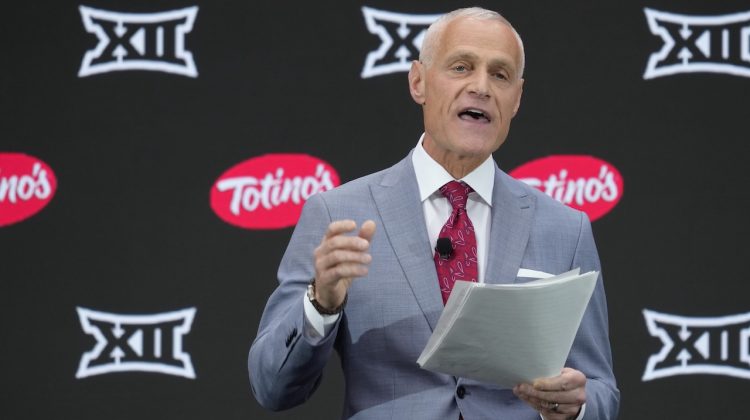
Meanwhile, Texas Attorney General Ken Paxton threatened to sue the Big 12 if action is taken against the Red Raiders and their presumptive starting quarterback as he recovers from a gambling addiction.
Just another day in college football.
The Big 12’s executive committee, which features presidents from Kansas, Kansas State and BYU, did not reach any conclusions. But the group agreed with the conference’s athletic directors that Sorsby, who gambled on Indiana during his redshirt season with the Hoosiers in 2022, should not be allowed on the field.
“We had a good and informative discussion,” commissioner Brett Yormark said in a statement issued by the conference.
“Sentiment among the Executive Board was no different from what we heard from the ADs earlier this week. Our discussion with the full Board will determine our course of action, and all options remain on the table.”
Clarity could come next week when Yormark meets with the full board of university presidents.
Five thoughts on the matter:
1. Big 12 bylaws and the super-majority
The question of the hour, day and week is whether the Big 12 would take action against the Red Raiders if they allow Sorsby to take the field once his two-game suspension ends. (He is scheduled to miss matchups with Abilene Christian and Oregon State but be available for the Sept. 19 showdown against Houston.)
Both Texas Tech and the Texas Attorney General’s Office have signaled their intent to sue if the Big 12 attempts to penalize the school, with a postseason ban as one possible option.
Will the Big 12 take action against one of its own?
Can the Big 12 take action against one of its own?
Few know the legal terrain better than Tom Mars, an attorney who has beaten the NCAA in court numerous times over the years.
On Wednesday, Mars wrote on the social media platform X that a super-majority vote of Big 12 presidents (at least 12) “have almost unlimited discretion to sanction Texas Tech.”
“What’s more,” Mars noted, “they also have the authority to amend the Big 12 Bylaws at any time to specifically require the immediate suspension or dismissal of any school which knowingly plays an athlete who has admitted to placing bets on his own team.”
And what if Texas Tech or the Texas Attorney General attempts to sue the conference?
“Under Texas law,” Mars explained, “courts defer to the internal affairs and rules of private associations and will not substitute the court’s judgment for the association’s decision (such as membership revocation, rule-making, or expulsion) unless the association failed to follow its own bylaws or acted in bad faith.
“So how does Texas Tech get around that?”
We should know more early next week.
2. The Fox and ESPN factor
Another possible option for the Big 12: force Texas Tech to forfeit any game Sorsby plays.
Of course, there are sweeping competitive and financial consequences to that approach. It would undermine the schedule strength of any Big 12 teams contending for the College Football Playoff and, more significantly, it would eliminate game inventory for Fox and ESPN.
The networks have media rights contracts with the conference valued at approximately $500 million annually and would not be happy with 11 Texas Tech dates being removed from the calendar. (The Oregon State game is part of the Pac-12’s media deal.)
Naturally, Fox and ESPN would want to be compensated for tens of millions of dollars in lost inventory. But how much resistance would they muster?
After all, they depend on the public’s voracious interest in college football. If Sorsby takes the field and establishes a precedent for players to bet on their own teams with limited consequences, the integrity of the competition would be called into question.
That could impact interest and TV ratings — and the bottom line for Fox and ESPN.
They need the sport to remain credible, perhaps even if it means sacrificing some inventory.
3. Unprecedented public glare
In stumbling, bumbling fashion, Texas Tech officials continue to make the case that they are focused on Sorsby’s recovery from his gambling addiction.
Athletic director Kirby Hocutt issued a statement Wednesday in which he stopped short of explicitly stating that Sorsby will play once his suspension ends but said: “Pulling him out of a structured environment, away from his team and his support system, does not protect anyone.”
That raised a question on the Hotline: Would competing in the fall actually be the best thing for Sorsby’s mental health?
He would be reviled in visiting stadiums like few players in the sport’s history.
Social media scorn and threats to his personal well-being would (unfortunately) rise to unprecedented levels.
Every interception would prompt speculation that he was betting against the Red Raiders.
The pressure and scrutiny could rise to an unbearable level.
Would that be good for his mental health?
4. Self-interest is king
Texas Tech’s billionaire booster, Cody Campbell, has attempted over the past year to position himself as the champion of the little guys in college sports — an advocate for the Olympic sports and for every football program not in the SEC and Big Ten.
His influence is oozing from the Protect College Sports Act (PCSA), the bipartisan bill that targets the Big Ten and SEC and was co-sponsored by Sen. Ted Cruz (R-Texas), who is from Campbell’s home state.
When asked for a comment on the Sorsby situation after the preliminary injunction was issued, Campbell called it an “unfortunate situation” resulting from a “broken system” and said he was “doing everything I can to fix it.”
Perhaps Campbell could explain how supporting Sorsby’s return to the field is in the best interest of college sports.
Sorsby broke the one unbreakable rule at the heart of sports competition at all levels, in all leagues and across every continent: Don’t bet on your own team.
How is allowing Sorsby to return — after a paltry two-game suspension — the right move for the greater good?
It would merely inspire other athletes to do the same, knowing the repercussions might be limited (if they get caught). And it certainly would cause viewers of Texas Tech games in which Sorsby plays to question whether his actions are authentic.
The reality is, Campbell can’t explain his hypocrisy.
He is no better than anyone else in college sports. He just has more money and a larger platform. And he supports whatever policy or strategy is best for Texas Tech.
It’s better for the Red Raiders if Sorsby plays.
It’s better for the Red Raiders if the SEC and Big Ten are prevented from joining together to form a super league — a key component of the PCSA.
And it’s better for the Red Raiders if conferences pool their media rights, which is also addressed in the PCSA and, many believe, would reduce the revenue gap between the Big Ten and SEC and everyone else.
Campbell should drop the pretense, abandon any attempt to claim the moral high ground and just admit he’s motivated by craven self-interest, just like so many others in college sports.
At least that would be authentic.
5. The risk of unintended consequences
Everything Texas Tech and Campbell have done in the past two years — from the PCSA support to the Sorsby stance to their massive NIL investment — is designed to win games and build their brand.
They don’t want to be left behind when college football’s underlying structure morphs into whatever’s next at the end of this decade or the early 2030s.
That could be a super league of 30 or 40 teams.
That could be expanded versions of the SEC and Big Ten, with 20-to-24 members each.
Nobody knows what’s coming, but something’s coming. And Texas Tech is hell-bent on claiming a seat. The best way to ensure inclusion? By thriving on the field and doing everything possible to limit the hegemony of the SEC and Big Ten.
But their actions, and particularly their support of Sorsby’s return, could backfire.
They aren’t the defenders of the little guys or the bold disruptor with a billionaire backer — the 2020s version of what Oregon became 15 years ago.
They are, simply, institution non grata.
The self-inflicted damage to their reputation within the industry is incalculable. In whatever structure arises in the 2030s, nobody will want them.
So congrats, Red Raiders, on completely misplaying your hand.
*** Send suggestions, comments and tips (confidentiality guaranteed) to wilnerhotline@bayareanewsgroup.com or call 408-920-5716
*** Follow me on the social media platform X: @WilnerHotline
Related posts:
 Wilner Hotline – Pac-12 football: What to watch during spring practice
 Pac-12 business: Scottsdale meetings feature loaded agenda, but no decision expected on you-know-what

(AP Photo/Elaine Thompson)
Big 12 baseball tournament headed west starting in ’26 as conference deepens roots in new footprint
(AP Photo/Jeffrey McWhorter, File)
SEC commissioner Greg Sankey talks CFP format, differences with the Big Ten, March Madness expansion (and everybody listens)