
 Sports360AZ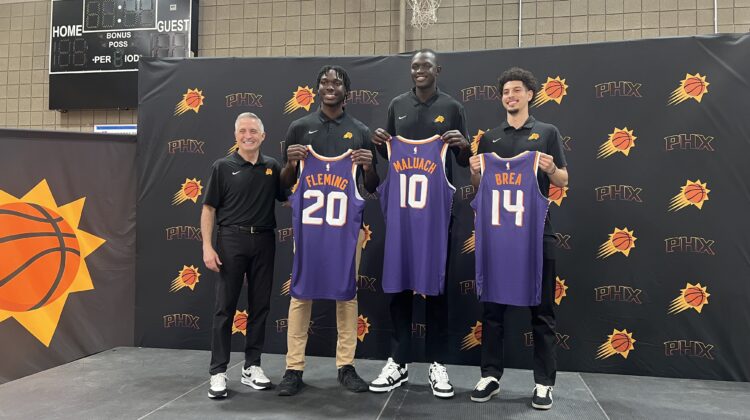
By Gerald Bourguet
All eyes are fixed on the San Antonio Spurs and New York Knicks as Game 1 of the NBA Finals tips off Wednesday night, but for the other 28 teams whose offseasons have already begun, there’s plenty of prep work to be done for the 2026 NBA Draft.
Despite only having one pick in this year’s draft at No. 47, the Phoenix Suns have likely been in draft evaluation mode for weeks now. Given Brian Gregory’s history of moving all around the draft, there’s a decent chance Phoenix finds a way yet again to move up in the pecking order.
In 2024, the Suns traded down from No. 22 to No. 28 to select Ryan Dunn, then packaged some additional second-round picks to move back into the second round, all the way up to No. 40 for Oso Ighodaro. Last year, Phoenix entered the draft with No. 10, No. 29 and a handful of future second-rounders, and after a series of moves, they left with Khaman Maluach (No. 10), Rasheer Fleming (No. 31) and Koby Brea (No. 41).
Long story short, Brian Gregory isn’t shy about wheeling and dealing on draft night, especially when it comes to moving up in the second round to put Phoenix’s revamped scouting department to good use. With the Suns’ only pick coming at No. 47 this year, it wouldn’t be shocking to see them move up a few spots if someone they really like is still on the board.
How far they’re willing (or able) to move up is the question. More than likely, it’ll only be a few spots in the second round. The Suns are banking on continuity and player development this summer, which could rule out more aggressive movesthat involve trading key players for a higher pick, and we’ve already covered the various reasons Phoenix should value the two future first-rounders that become trade-eligible on draft night.
If key players and the Suns’ only two tradeable firsts are both out, that might just leave Phoenix with Royce O’Neale, Grayson Allen and/or Mark Williams in the “potentially expendable” category. It’s hard to see any of those guys having enough juice on the trade market to net the Suns a first-rounder in this year’s draft.
Then again, the fun thing about the NBA is how unpredictable it can be! And since we’ve already gone through a few teams that might make sense as trade partners if the Suns decide to move up in the draft, today we’re going to take a look at a few projected first-round talents that might be worth Phoenix’s time if they’re able to move up far enough.
1. Yaxel Lendeborg, Michigan
If the Suns are going to trade into the first round…might as well do it big, right? It’s probably unrealistic to expect Phoenix to work their way up to the lottery, which is where they’d need to be if they wanted to draft Yaxel Lendeborg…but a guy can dream, right?
One of three potential lottery picks coming from the defending national champs at Michigan, Lendeborg is the exact type of two-way forward the Suns need more of. Averaging a well-rounded 15.1 points, 6.8 rebounds, 3.2 assists, 1.2 blocks and 1.1 steals per game, Lendeborg is just a very good, well-rounded player who can do a little of everything. From his massive strides in transition to his passing chops to his ability to get downhill, this is the type of player who can come in and immediately contribute on any NBA bench.
2026 Yaxel Lendeborg pic.twitter.com/JDqikQ67r8
— Pitless (@pitlessball) April 7, 2026
Defensively, Lendeborg is a switchable wing who would give Jordan Ott yet another multi-positional defender to work with for the long-term. At the collegiate level, he proved he could contain anyone from ball-handlers at the point of attack to bigger power forwards, and he routinely made plays off the ball as a help defender and chase-down block artist.
If he wasn’t so old, Lendeborg would probably be a certified top-10 pick. Although he’ll turn 24 before the start of his rookie year, he’s one of the more polished prospects in the draft and looks ready to contribute from day one on a winning NBA team. He measured just under 6-foot-9 barefoot, with a 7-foot-3 wingspan and a 9-foot standing reach, which gives him the size to play the 3, the 4 and maybe even the 5 in small-ball lineups.
Lendeborg also made 37.2 percent of his 4.5 long-range attempts per game last season. As The Athletic’s Sam Veceniepointed out, that was mostly due to a strong finish to the year, where he shot a blistering 48.1 percent from deep over his final 16 games. But if that 3-point shot can translate to the NBA level, his balance of size, skill and connective passing in the frontcourt would make him a welcome addition to any roster — especially one like Phoenix that needs more plus-sized forwards.
The ceiling might not be as high as some of the guys who will go ahead of him in the top 10, but Lendeborg has one of the highest floors in this draft and has even drawn some Aaron Gordon comparisons. Most mock drafts have him going 12th to the Oklahoma City Thunder or 14th to the Charlotte Hornets, so if the Suns were to find a way to trade into the late lottery, it wouldn’t get much better than this.
2. Ebuka Okorie, Stanford
Between Darius Acuff Jr., Kingston Flemings, Mikel Brown Jr., Labaron Philon Jr., Christian Anderson and Bennett Stirtz, there are plenty of exciting point guards to discuss in this year’s draft class. Despite the consensus that he’s in a tier below those guys, Ebuka Okorie could be one of those late first-round steals that makes people wonder a few years down the road how he ever fell that far.
Although he’s 6-foot-1 barefoot and looks pretty scrawny out there at only 186 pounds, Okorie has pretty impressive length for a smaller guard, with a nearly 6-foot-8 wingspan and 8-foot-2 standing reach. More importantly, he has a breathtakingly quick first step and an unrelenting approach to attacking the rim.
As a freshman, this 19-year-old led the ACC in scoring with 23.2 points per game on 46.5 percent shooting. He wasn’t overly impressive as a playmaker (3.6 assists a night) or efficient 3-point shooter (35.4 percent), but his long-range percentage was actually not too shabby when one considers he was taking 5.7 attempts per game.
The flashes of brilliance are undeniable. Okorie’s elite acceleration, exceptional handle and slithery deceleration are big reasons why his rim frequency was astronomically high for a guard his size. As The Ringer’s Kyle J. Mann put it, he was “like electricity finding the ground when it came to paint touches.”
2026 Ebuka Okorie pic.twitter.com/1Qh02BYqfP
— Pitless (@pitlessball) April 9, 2026
Okorie showed plenty of on-ball juice as one of the toughest one-on-one covers in all of college basketball, with the ability to create space on step-backs, or get defenders to bite on pump fakes before pulling through for a running leaner. While it’s tough to see him becoming some heliocentric centerpiece that regularly takes tough shots off the bounce at the NBA level, Okorie might be more attainable than the crop of guards listed above, sliding into the late first round or maybe even early second round.
The reason is there are a few warts that come with his game (like pretty much every draft prospect ever). Despite how frequently he got into the paint and some of the nifty, crafty, athletically clever finishes he added to his end-of-year highlight reel, Okorie only shot 52 percent at the rim in the half-court. Due to his lack of size, he’ll have to become muchbetter at converting around the basket when he’s up against the trees of the NBA.
The Suns don’t need a point guard right now between Devin Booker and Collin Gillespie, and even for those clamoring for Phoenix to put a true point guard next to Book, expecting a 19-year-old rookie to fill that role would be foolishly optimistic. But in looking towards the future, and just in terms of developing young talent, adding this type of young, dynamic scorer with room to refine his game sure wouldn’t hurt.
It’s not often you find lottery-level upside near the end of the first round, so if the Suns wind up trading into that range, he’s definitely a prospect to keep in mind.
3. Joshua Jefferson, Iowa State
If you’ve listened to Suns After Dark’s draft episode from last week, or read just about anything Suns-related that mentions Joshua Jefferson, you’ve probably already heard him described as a “smaller Oso Ighodaro” because of his passing chops.
And that’s certainly where Jefferson’s most NBA-ready skill resides. He’s been called arguably the best passer in this draft class (regardless of position) by a few draft experts, and watching the tape, it’s pretty obvious why:
The player that we think will be a very good NBA player and getting no love – Joshua Jefferson
Not elite at anything but does so many things well
Fits a great 3/4 mold in the league and, by ALL accounts, is a big time winner pic.twitter.com/B07pOBr06E
— Hoop Herald (@TheHoopHerald) May 11, 2026
In his final year at Iowa State, Jefferson averaged 16.4 points, 7.4 rebounds, 4.8 assists and 1.6 steals per game. He shot 47.1 percent from the floor, including a career-best 34.5 percent from 3 on 3.1 attempts per game. His 3-ball still needs some work in order to spread the floor at the NBA level, but he obviously has more range than Ighodaro at this point, if we’re carrying on with that comparison.
Jefferson’s measurements at the NBA Draft Combine may have hurt his draft stock, since he came in under 6-foot-8 barefoot, with a nearly 6-foot-11 wingspan. Despite his passing skills, he’s more of an undersized big with some wing-based skills, rather than a plus-sized wing with the build of a 4. That could be enough to drop him into the second round, but whether it’s late first round or early second round, Phoenix would have to trade up to get him.
As Ben Pfeifer pointed out, Jefferson probably won’t be facing up and attacking a set defense in the pros like he did in college, but that’s actually a good thing, since a reduced role and better spacing around him should open up his passing abilities even more.
Jefferson isn’t the type of offensive fulcrum that any NBA team will operate through, but there’s value in having capable ball-handlers and playmakers at multiple positions. That could make him an overqualified role player, especially as a secondary playmaker and “jack of all trades, master of none” type of sub.
He was no slouch as a scorer at the collegiate level, employing some smooth spin moves when he got downhill. But he could still use some work in that regard, since he was most effective driving from the midrange rather than the perimeter. If that doesn’t change, and if he can’t shoot, he could cramp NBA spacing, especially if he’s no longer a main offensive hub at the pro level.
Jefferson is already 22 years old, so he’s another low-ceiling, high-floor kind of prospect. But he’s a great processor, impressive passer and deflection machine on the defensive end, which should be enough to make him an effective role player in the NBA.
4. Christian Anderson Jr., Texas Tech
In terms of projected draft range, Christian Anderson is expected to go somewhere in the late teens or early 20s at worst by most mocks. That’s the reason he’s so low on our list: If the Suns are trading up this high into the first round, they should just go for it all the way and try to land someone like Yaxel Lendeborg. Trading up this high for a rookie point guard just doesn’t make much sense unless you’re absolutely sure he’s the future of the position for your franchise.
To that end, Anderson only comes in at No. 4 on our list, because while he’s an intriguing prospect, he’s not a sure fire thing either. For starters, his lack of size could be a problem at the next level. Anderson came in at just under 6-foot-1 barefoot, with a 6-foot-6 wingspan and 8-foot standing reach. Even with a plus wingspan, it’s hard to overcome that type of size deficiency at the next level, especially since he’s only 180 pounds.
However, there’s a reason Christian Anderson Jr. is mocked where he is: He’s arguably the best shooter in the entire draft class. The Texas Tech product drilled 41.5 percent of his 3s as a sophomore, which is incredibly impressive for a guy who launched 7.9 of them on a nightly basis. As a spot-up sniper or shooter off the bounce, Anderson is as good as it gets in this year’s draft class, and he routinely drilled clutch buckets as well.
Anderson is also a solid playmaker in the pick-and-roll, with incredible ball-handling skills to boot. He averaged a conference-high 7.4 assists per game last year, and while he may not look like much from a physical standpoint, his ability to wiggle through defenses with the ball on a string is impressive to watch.
Christian Anderson (PG)
🟢 Sniper (41% from 3 on nearly 8 3PA)
🟢 Elite vision, elite playmaker (7.4 APG)
🟢 Pick-and-roll maestro
🟢 Crafty finisher with soft touchAnderson leads all guards in the class in EFG% with an EFG of 59.7% ‼️ pic.twitter.com/g045A3OZL9
— DraftCentral (@draftcentralnet) June 2, 2026
All in all, there’s a lot to like about Anderson’s game, from his shooting prowess, to his ability to set up teammates with soft-landing passes, to his “Nash dribbles” in the lane that help him evade defenders and snake through the teeth of the defense.
However, because he’s smaller and not particularly strong, he tends to avoid a lot of contact. He’ll have to improve his ability to score from pretty much everywhere inside the paint, and it was telling that Anderson actually averaged more 3-point attempts (7.9) than 2-point attempts (5.2) on a nightly basis. While there’s a place for players like that in the NBA, it’s usually spot-up shooters at the 2 or the 3, not lead ball-handlers charged with leading the offense.
Watching his highlights, it’s tough to see him creating that same separation against the length of NBA defenders, especially if he can’t get downhill and put pressure on the rim with such a frail frame.
Defensively, while he was a committed and engaged defender at Texas Tech, he’s going to be a frequent target in the NBA due to his smaller stature. That will require teams to either hide him, insulate him by surrounding him with plus defenders, or simply keep him on the bench until he’s stronger and more capable of holding his own on that end.
There’s a lot to like about Christian Anderson, but truthfully, if the Suns were to trade up in the draft, they might be better off just targeting Okorie later on in the first round.
5. Chris Cenac Jr., Houston
If the Suns are looking for someone who can help fill out their frontcourt rotation within the next 1-2 years, Chris Cenac is not the guy they’re looking for. If they’re envisioning a stretch-big to pair with Khaman Maluach and Rasheer Fleming for the long haul, however, there’s enough upside here to be worth a look.
The 19-year-old out of Houston is a polarizing prospect. Some see him as a lottery-level talent, while his biggest critics thought he should’ve stayed in college for another year. In any case, he’s projected to go somewhere in the 20s by most mocks, and The Athletic’s John Hollinger noted that Cenac’s measurements at the NBA Draft Combine — 6-foot-10 barefoot, with a massive 7-foot-5 wingspan and 9-foot standing reach — were probably enough to prevent him from dropping out of the first round.
Aside from the raw physical attributes, Cenac is a perimeter-oriented big who has a burgeoning offensive game. He’s got a smooth, composed midrange jumper with a high release point, which makes it a very difficult shot to block since he’s basically 7 feet tall in shoes.
Still raw and full of upside but absolutely love the rebounding ability from Houston freshman big man Chris Cenac Jr.
Does a fantastic job of finding a way to create additional posessions on the offensive side of the ball.
Battles for positioining and love the desire to at… pic.twitter.com/nHvHrt5lpA
— Tyler Rucker (@tyler_rucker) April 15, 2026
If the Suns don’t fully believe that Maluach’s 3-ball will ever develop, adding a big like Cenac to space the floor is a tantalizing notion. Plenty of teams employ dual-big lineups now, so it’s certainly fun to think about putting him next to another 7-footer like Maluach (not to mention Fleming’s unholy 7-foot-5 wingspan) for a super-sized frontcourt.
However, the results don’t exactly warrant Cenac’s jumper-heavy approach just yet. He’s overly reliant on a midrange jumper that doesn’t go down enough to justify how often he settles for it, and he only made 33.3 percent of his 2.4 long-range attempts per game as a freshman. As The Athletic’s Sam Vecenie pointed out, Cenac took a whopping 141 jump shots for the Cougars, compared to just 47 shots at the rim. That’s only 1.3 rim attempts on a nightly basis!
Given his incredible size, build and athleticism, it’s a shame he doesn’t utilize those natural gifts more around the basket. It’s especially curious for a guy who’s a beast on the offensive glass and served as an engaged, physical on-ball defender. As Ben Pfeifer said, developing that physicality and downhill approach will be his swing skill at the NBA level.
At this point, Cenac is far too contact-averse to play the 5, and he’s not good enough as a shooter to project as a sure thing at the 4 just yet either. It’s unfortunate, because he’s an excellent rebounder, hauling in 7.9 per game. But until he tweaks his approach to include more rim attacks, embraces more contact, and becomes a more consistent presence as a rim deterrent or help defender, all that potential feels like it’s still a few years away.
Honorable Mentions: Aday Mara, Morez Johnson Jr., Karim Lopez
For more of Gerald Bourguet’s Suns work, check back with Sports360AZ on a weekly basis, subscribe to his Patreon articles and podcast at Suns After Dark, or follow him on Twitter.
Related posts:
 Solar Panel Ep. 43 The Suns have a point guard problem
(AP Photo/Matt York)
Cam Johnson Is The Man For The Suns This Week
New Orleans Pelicans forward Naji Marshall, (AP Photo/Mark J. Terrill)
VIDEO -Suns v New Orleans to open playoffs, Channing Frye Previews
(AP Photo/Tony Gutierrez)
Suns taken down by Dallas in Game 3