
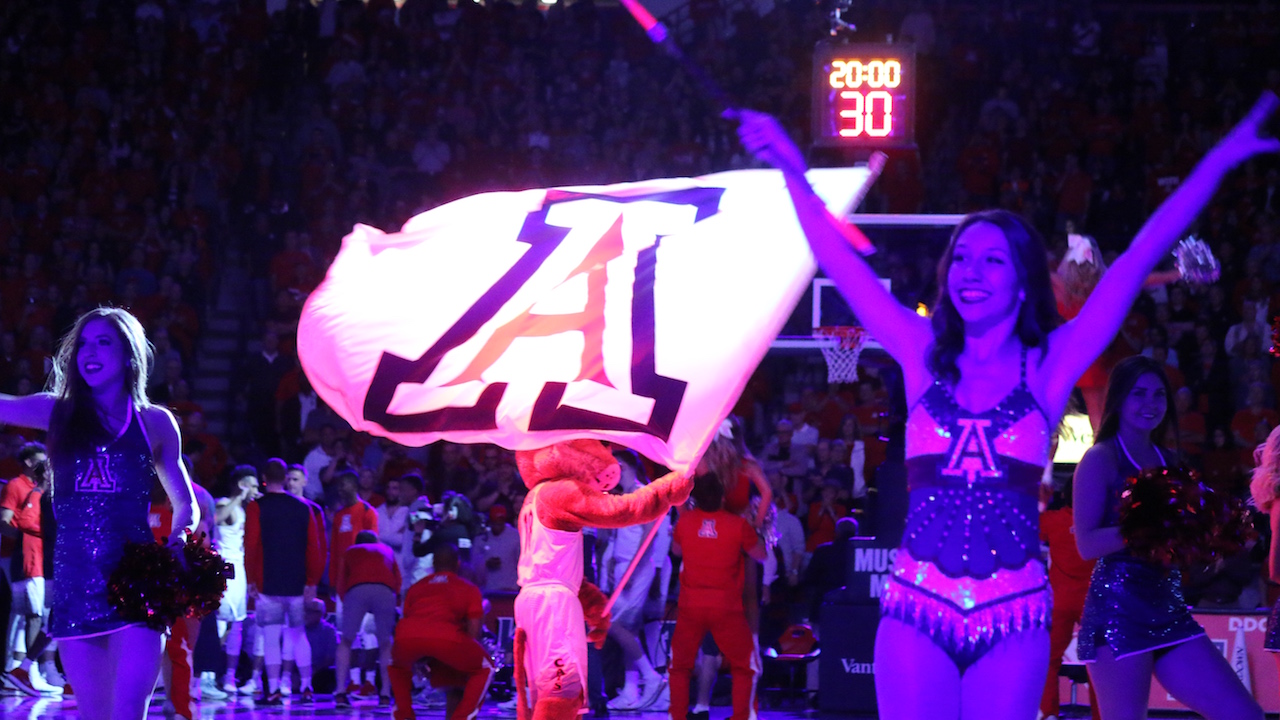
The contract is signed, the leverage has been optimized, and the reporting lines are established. Time for the case study to begin.
There’s nothing at stake except, perhaps, the future of Arizona athletics.
At this fragile point in college athletics, with the roiling present and uncertain future, the Wildcats decided to zag when so many peers have zigged. What happens next — over the coming years, not months — will be fascinating to watch.
But before we delve into the university’s decision to not only prioritize its men’s basketball program but codify that place of primacy, let’s offer a few morsels of context.
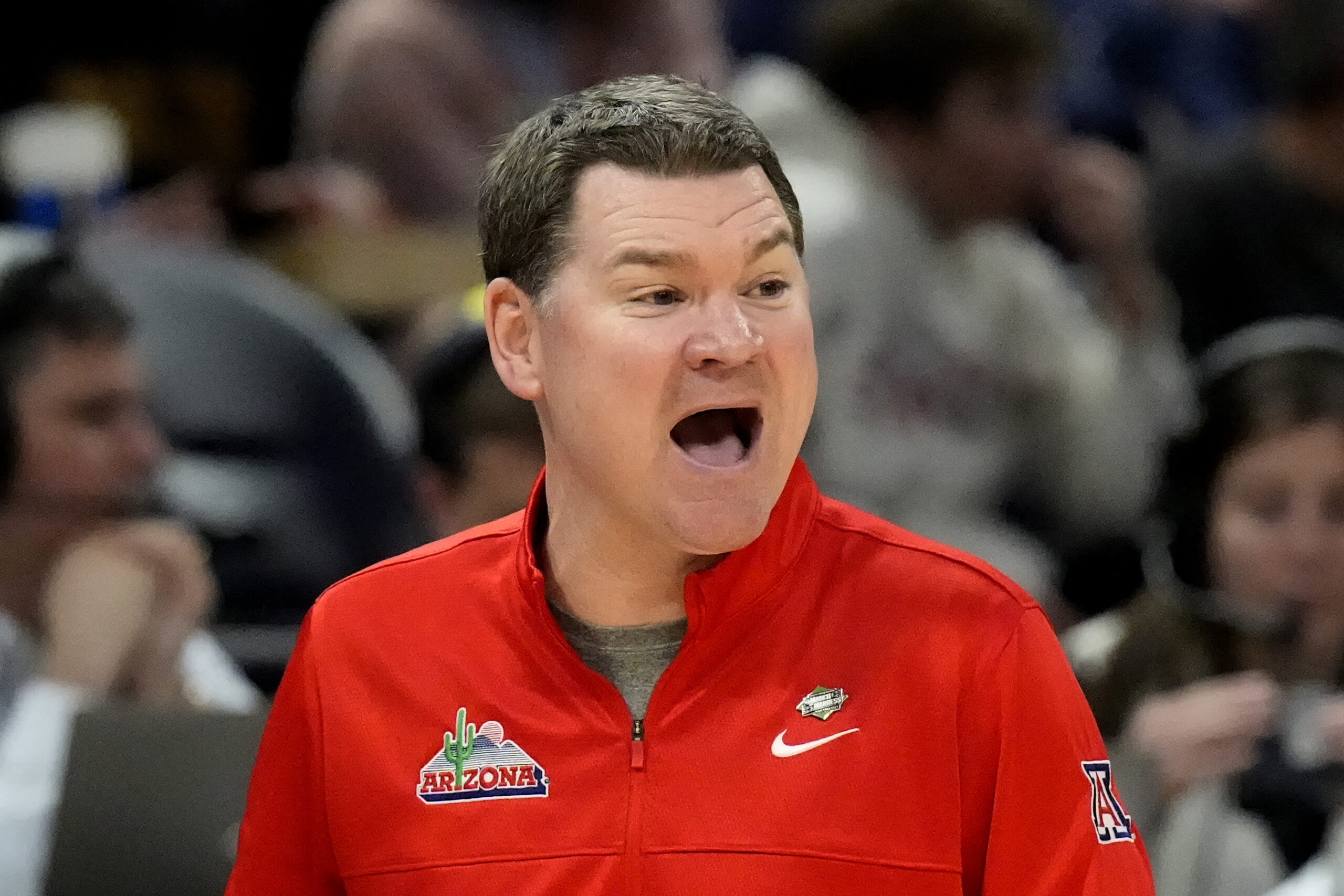
Prior to the blowout loss to Michigan in the Final Four, coach Tommy Lloyd revealed that he had agreed to a new deal with the Wildcats and was not a candidate for the North Carolina vacancy.
It was, of course, a massive win and huge relief. Lloyd is not only a stellar coach but a tremendous fit for the program, the university and the community.
The salary figure and contract duration are immaterial for the purposes of the case study set to unfold. Suffice it to say, Lloyd is well compensated.
 Here’s what matters:
— According to CBS Sports, Lloyd will report directly to university president Suresh Garimella, thus circumventing athletic director Desiree Reed-Francois.
Exactly what that means is unclear. Certain issues can, and probably should, be handled by traditional athletic department mechanisms.
But it appears Lloyd can go straight to the top if he feels limited in any sense.
(Although not commonplace, there are instances in college football and basketball in which the head coach has a straight line to the president.)
— In his public comments on the contract, Lloyd avoided details but explained his vision for the program, and it sounded quite familiar:
“Arizona basketball needs to become a locomotive, where everything surrounding it is pushing it forward.
“It’s my opportunity right now to kind of be the captain of the ship. But just putting everything we have behind our program, and the No. 1 thing that starts with is just energy and effort … So just getting that alignment, and I think we are taking big steps towards doing that.”
From here, the subtext was clear: Lloyd wants to recreate the internal alignment he experienced during 20 years at Gonzaga, where every facet of the university was “pushing” the basketball “locomotive” forward. That’s the only way a tiny private school in Spokane becomes a national power.
Combine that vision with the new reporting structure — from Lloyd’s office straight to Old Main — and it’s safe to assume his concern was the allocation of resources for NIL and revenue sharing. He wanted to ensure basketball received the dollars needed to compete for the national championship.
Which is, after all, his job.
To compete for national championships, the Wildcats seemingly will need at least $12 million annually for their roster — that’s internal revenue sharing and external NIL — and the figure likely will exceed $15 million sooner than later.
But football needs even more. In order to construct a roster capable of thriving in the Big 12, coach Brent Brennan needs a minimum of $20 million annually. (Texas Tech is believed to be over $30 million.)
Does Arizona have enough deep-pocketed donors to support both programs at the level needed for success?
Best we can tell, the Wildcats don’t have an equivalent of Oregon’s Phil Knight or Texas Tech’s Cody Campbell or BYU’s Ryan Smith — billionaires willing to fund the pursuit of championships.
Maybe that state of play changes over time. But if the dollars are limited, it will be difficult for Arizona to provide the optimal NIL resources for both programs.
Based on Lloyd’s direct line to Garimella, it seems the basketball program would be in line to receive the marginal dollars — in simplified terms: the last $3 million available that could be used for an elite point guard or a star edge rusher.
And that, folks, brings us to the case study.
In choosing to prioritize basketball, Arizona would be leaning into its history. It has been a basketball school since the day Lute Olson set foot on campus 40-something years ago, whereas football has been successful merely in fits and spurts.
The problem? It’s a football world.
Granted, football has dominated college sports for eons, but the economic landscape has shifted. Talent acquisition is now based largely on the NIL and revenue-sharing dollars available from one program to the next, one campus to the next.
What’s more, it’s a football world on the brink of fracturing.
Another round of realignment is inevitable in the early 2030s, when the series of media contracts holding college sports together all expire.
At that point, either the Big Ten and SEC will expand again, relegating the leftovers in the ACC and Big 12 to a third-rate existence, or a football super league will form.
Some schools are locks for inclusion in whatever structure arises: Ohio State and Texas, Michigan and Georgia, Notre Dame and Alabama — the usual suspects.
For everyone else, admission to the club will depend on the media value and competitive excellence of the football program.
Even Indiana, a five-time NCAA basketball champion, realized the road to salvation was 100 yards long.
“In the Big Ten, you need to be relevant in football to be a relevant member in your conference,” Hoosiers athletic director Scott Dolson told Yahoo in the fall of 2024.
“We don’t take for granted that we’re always a long-standing member of the Big Ten. We want to pay our fair share and be a valued member in football.”
There are other examples of blue blood basketball schools placing unprecedented emphasis on football — from North Carolina hiring Bill Belichick to Duke spending $8 million last offseason to sign quarterback Darian Mensah (to a two-year NIL deal).
As an industry source said: “In 2026, would you rather be Kansas or Indiana?”
Is Arizona doomed to be left behind in the 2030s because of a commitment made to basketball in 2026?
Not necessarily. The situation is breathtakingly fluid, both regionally and nationally.
Maybe Brennan and his staff can do more with less more often than not.
Perhaps Arizona will fund football at the level necessary for consistent success while keeping basketball properly resourced.
We aren’t privy to the details of the Wildcats’ NIL game — to the checks written and pledges made. But it doesn’t appear their supply of NIL dollars is unlimited, and we know which sport will shape the landscape in the 2030s.
The Wildcats gave Lloyd what he wanted and, from that moment onward, became one of the most intriguing long-haul experiments in major college sports.
*** Send suggestions, comments and tips (confidentiality guaranteed) to wilnerhotline@
*** Follow me on the social media platform X: @WilnerHotline
Related posts:
Oregon running back Bucky Irving, (AP Photo/Amanda Loman)
Pac-12 rewind: UW and Oregon dominate, WSU meets the moment, Utah and USC survive in telling Week 4 action
Southern California wide receiver Brenden Rice, (AP Photo/David Zalubowski)
Saturday Night Five: USC’s offensive defense, UW’s desert escape, Cal’s big win and more
Washington State forward Jaylen Wells (AP Photo/Young Kwak)
Pac-12 MBB power ratings: Washington State as an NCAA bubble team? Washington State as an NCAA bubble team! Mailbag: Week 1 is average nationally (but solid on the West Coast), Pac-12 vs. MW cash, Big Ten private capital and more
Jon Wilner

Jon Wilner has been covering college sports for decades and is an AP top-25 football and basketball voter as well as a Heisman Trophy voter. He was named Beat Writer of the Year in 2013 by the Football Writers Association of America for his coverage of the Pac-12, won first place for feature writing in 2016 in the Associated Press Sports Editors writing contest and is a five-time APSE honoree.