
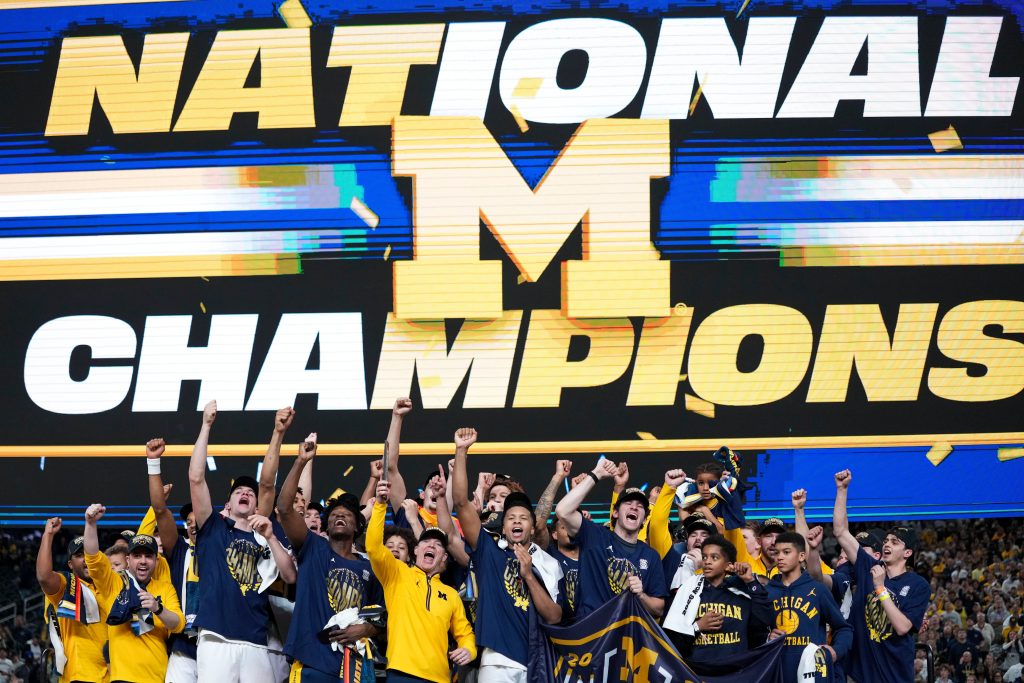
Michigan beat back Connecticut in the NCAA championship Monday night to complete a six-game blitz through the tournament and a three-sport sweep for the Big Ten.
For the first time since the SEC hit the trifecta in 2008, one conference has claimed the football and men’s and women’s basketball championships in the same academic year.
And the Big Ten did it resoundingly:
— Indiana went 16-0 and won the College Football Playoff — no other team finished with fewer than two losses — to secure the conference’s third consecutive football title following the coronations of Michigan (2023) and Ohio State (2024).
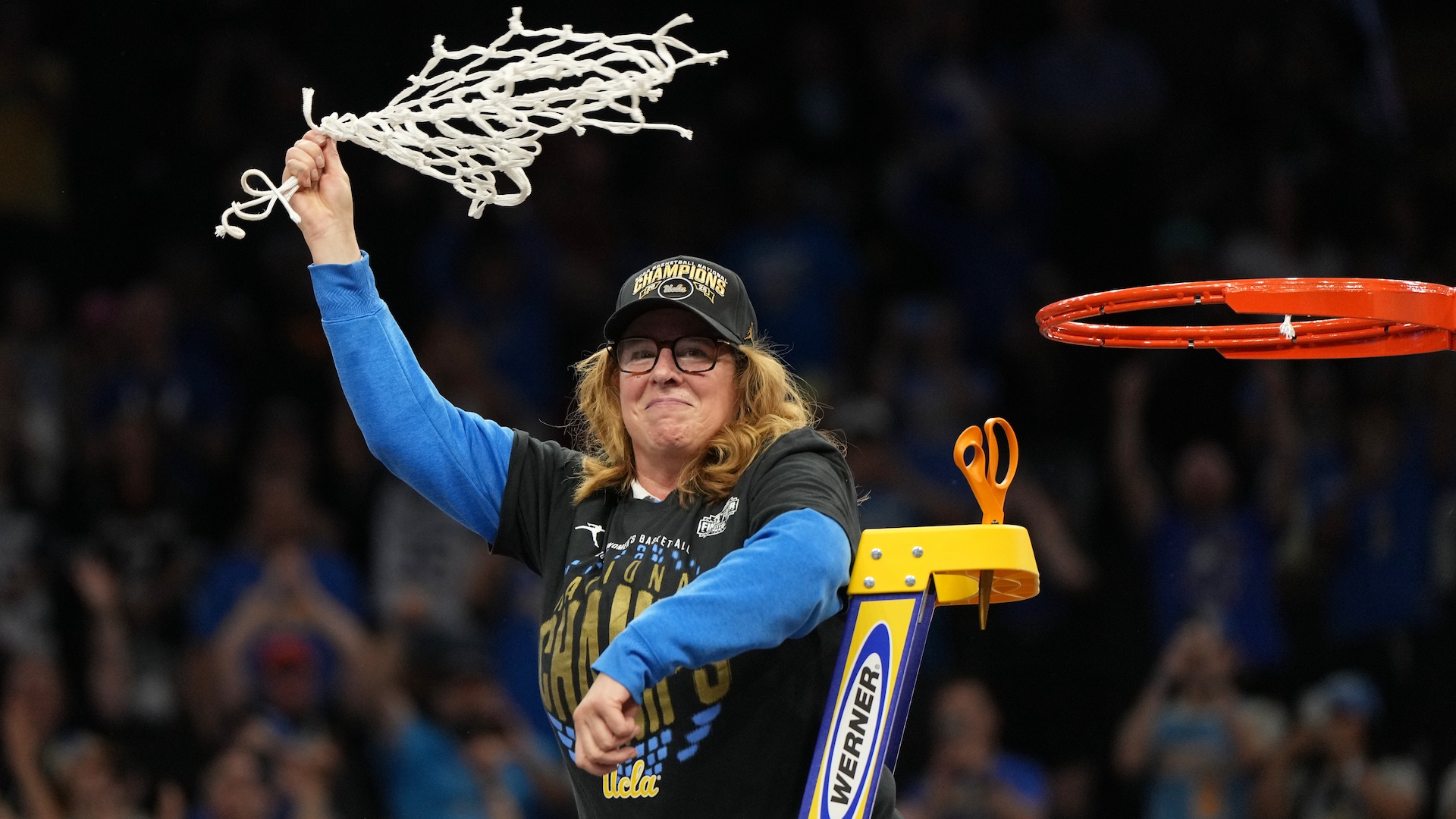
— UCLA went 37-1 and walloped mighty South Carolina in the championship for the Big Ten’s first women’s title since 1999 (Purdue).
— The Wolverines won five of their six NCAA tournament games by double digits for the conference’s first men’s title since 2000 (Michigan State).
 The collective ascent comes during a new era of college sports defined by unfettered player movement and paychecks waiting at each successive stop. The talent flows up like never before. Michigan’s starting lineup, for example, was comprised entirely of transfers.
That dynamic won’t change despite President Donald Trump’s executive order, issued last week, that attempts to limit penalty-free transfers and shorten eligibility clocks. (Many sports law experts believe the order is unenforceable, assuming it’s eventually challenged in court.)
Only one thing will materially alter the landscape: a collective bargaining agreement (CBA) between athletes and their schools or conferences. But given that any CBA would require the players to unionize, that any players’ union would require employment and that the schools are loath to take that step, the industry appears to be years away from a CBA.
Does that mean the Big Ten will reign indefinitely? Does it rent or own the throne?
Clearly, no conference is better set for success.
As the Hotline explained last summer following the House v. NCAA lawsuit settlement that created revenue sharing, the Big Ten possesses structural advantages over its primary rival, the SEC, that suggest a golden era has arrived:
— The Big Ten’s 14-state footprint (and Washington, D.C.) features 235 companies listed in the Fortune 500. The SEC footprint has 130.
— The Big Ten footprint features 12 of the top 25 media markets in the country, including four of the top five (New York, Los Angeles, Chicago and Philadelphia). The SEC footprint features just five of the top 25.
— Big Ten schools have a combined current enrollment of approximately 825,000 undergraduates compared to the SEC’s 600,000, an indication of the comparative size of the alumni bases.
— The gross domestic product of the Big Ten states was $12.5 trillion in 2024, while the GDP of the SEC states totaled $8.4 trillion.
Everything leans to the Big Ten, except talent. The SEC footprint, from Texas to Florida, encompasses more elite football players, particularly linemen.
But in many instances, cash trumps proximity. The Big Ten’s wealth — the wealth of its schools and its business communities — is a significant counterweight unlocked by NIL and made accessible by the transfer portal.
That said, the sample size remains a tad light.
Revenue sharing has been the law of the land for nine months. The NCAA began allowing penalty-free transfers only two years ago. NIL became legal in the summer of 2021 but required a few years to evolve.
Even the case for Big Ten championships as proof of a secular shift in the competitive landscape could be opposed:
— Michigan and Ohio State are the winningest football programs of all time. Their consecutive national championships aren’t necessarily indicative of an enduring, tectonic shift away from the SEC.
— Indiana is the ultimate unicorn, the result of the greatest short-term coaching performance (Curt Cignetti) in the sport’s history unlikely to be repeated by the Big Ten’s middle- or lower-tier programs
— The NCAA Men’s Tournament success, which included four teams in the Elite Eight and Illinois joining Michigan in the Final Four, was an outlier. After all, the SEC ruled the postseason last year, placing two teams in the Final Four and winning the national title (Florida).
— UCLA’s run to the women’s title, albeit extraordinary, comes as the SEC placed a team in the championship game for the fifth consecutive year.
Our hunch: The competitive rebalancing toward the Big Ten is indisputably real but perhaps not as sharp, or enduring, as the three-sport sweep in 2025-26 suggests.
The SEC, while seemingly not as prepared for the era as the Big Ten, will respond. It might take a few years, especially on the field. But we’re slightly skeptical of the Big Ten establishing lasting dominance remotely comparable to the SEC’s run of 13 national championships in the 17 seasons prior to the implementation of NIL.
There’s a more immediate issue at play, however — and its tentacles touch every facet of college football and basketball.
While watching Michigan claim its first basketball championship since 1989, the Hotline couldn’t help but notice Big Ten commissioner Tony Petitti. He was seated on press row behind the Wolverines’ bench, not more than 12 feet from coach Dusty May, with chief operating officer Kerry Kenny on one side and Wolverines athletic director Warde Manual on the other.
What was Petitti thinking as Michigan wrapped up the three-sport sweep?
In the past year, he has proposed a series of radical changes to the industry’s crown jewels — from the automatic qualifier model for the CFP and, more recently, the engorged 24-team format to an expanded NCAA Tournament that uses a straight-seeding model. (It would effectively force low- and mid-major teams to cannibalize themselves in an opening round.)
Petitti, his fellow Division I commissioners and NCAA executives are expected to approve tournament expansion (to 76 teams) later this month.
A decision on CFP expansion for the 2027 season could come later this year.
And there are myriad other issues in need of adjustment and refinement (hello, transfer portal).
Petitti is paid by the Big Ten to advocate for the Big Ten and create a landscape that best serves the Big Ten.
In many cases, what’s best for his employer is not what’s best for the Group of Six football schools and the low- and mid-major basketball programs.
That’s true, as well, for his counterparts in the ACC (Jim Phillips), Big 12 (Brett Yormark) and SEC (Greg Sankey).
But Petitti’s hand has never been stronger.
Will he use the strategic positioning to ram through a series of changes that benefit the Big Ten but undermine the collective enterprises (football and basketball)?
Or will Petitti straddle the line?
Admittedly, that’s a difficult task. The industry’s sprawling membership includes both Michigan and Eastern Michigan, both Alabama and South Alabama. One size does not fit all and should not fit all.
But popularity is not a forever existence. College football cannot become the NFL — and March Madness cannot lose its charm — in the relentless quest for cash.
The Big Ten has ruled college sports in 2025-26 and could very well remain on top for years to come.
With that leverage comes responsibility. It should be neither completely selfish nor entirely selfless — both paths are unreasonable and fraught. There’s a balance to strike in the vital months to come.
*** Send suggestions, comments and tips (confidentiality guaranteed) to wilnerhotline@
*** Follow me on the social media platform X: @WilnerHotline
Related posts:
(AP Photo/Ashley Landis)
Pac-12 basketball rewind: Big Three struggle, seeds remain muddled, Oregon on the bubble, ASU soars and more
Arizona head coach Jedd Fisch (AP Photo/Rick Scuteri)
Pac-12 Football X-Fr.Portal Winners and Losers
BYU guard Dallin Hall (30) scores against Baylor (AP Photo/Gareth Patterson)
Best of the West: What’s the deal with Brigham Young’s lofty NET ranking? It doesn’t reflect the flawed resume
(AP Photo/Rick Scuteri)
Pac-12 MBB power ratings: As parity dominates, the NCAA Tournament outlook deterioratesJon Wilner

Jon Wilner has been covering college sports for decades and is an AP top-25 football and basketball voter as well as a Heisman Trophy voter. He was named Beat Writer of the Year in 2013 by the Football Writers Association of America for his coverage of the Pac-12, won first place for feature writing in 2016 in the Associated Press Sports Editors writing contest and is a five-time APSE honoree.