
By Gerald Bourguet
Over the last month or so here at Sports360AZ, we embarked on a journey through the Phoenix Suns’ starting lineup, trying to pinpoint one specific area where each starter would need to improve in order to make this group work.
We took a look at Devin Booker’s pull-up 3 being the final missing piece in his game; the need for Jalen Green to supply more rim pressure; Dillon Brooks’ shot selection/tunnel vision; and Miles Bridges’ secondary playmaking.
But before we could wrap up that series with the center spot, Mark Williams tore his labrum, which means he’ll likely be sidelined until at least mid-February. Obviously when it comes to an injury like this, there are much bigger things at stakethan our weekly series, but it did mean we had to pivot a bit.
The main question is whether Khaman Maluach or Oso Ighodaro will get the start at center on opening night. There are pros and cons for each option, which is why we’ve decided make the case for (and against) each one.
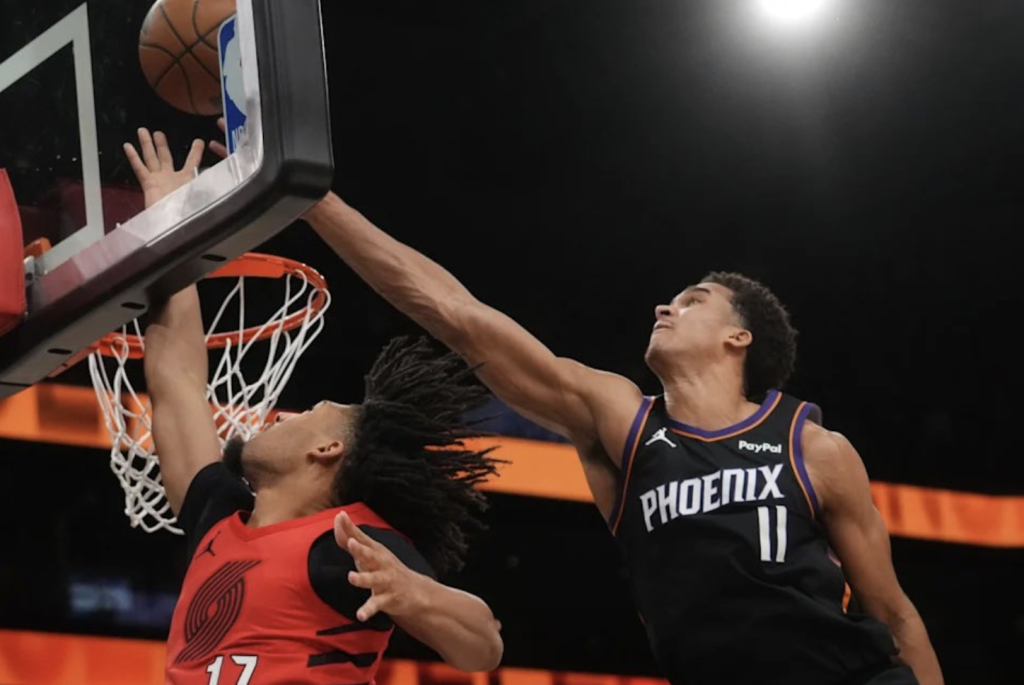
Last week, we examined the argument for Maluach to start, how he could immediately help the Suns if he’s ready for the job, and why he might be better-suited to come off the bench, at least to start the year. This week, we’ll be diving into Ighodaro’s case, including how he can help Phoenix’s starting lineup, where the Suns might struggle if he gets the job, and why he’s probably the safer bet to pencil in as the starter.
The case for Oso Ighodaro to start
Those who follow Suns After Dark already know some of the reasons Oso Ighodaro is underrated, under-appreciated and often misunderstood, but there are elements of his game that will seriously help this team whether he’s starting or coming off the bench.
The first is Ighodaro’s secondary playmaking. Nobody should be confusing him with Nikola Jokic or Domantas Sabonis, but Ighodaro is a high-IQ player who can facilitate dribble handoffs and backdoor feeds as a playmaking hub.
In this conversation, that secondary playmaking (and even just plain ol’ ball-handling) is arguably Ighodaro’s greatest advantage over Maluach. At 20 years old, Man Man barely brings rudimentary passing — let alone full-blown playmaking — to the table. Maluach’s assist percentage last season ranked in NBA’s zero percentile among bigs, and his assist-to-usage percentage ranked in the first percentile.
Ighodaro, on the other hand, ranked in the 74th percentile in assist percentage and the 91st percentile in assist-to-usage percentage. That disparity matters for a starting lineup that desperately needs to find ways to get Booker off the ball more and alleviate the playmaking burden that’s on his plate. Jalen Green, Dillon Brooks and even Miles Bridges aren’t going to ease that load much, but Ighodaro could legitimately help there.
Everyone thinks of shooting when they hear the word “spacing,” but Ighodaro’s passing ability can create a different type of spacing. Whether he’s operating on the perimeter or finding the open man on the interior as a short roll playmaker, Ighodaro’s passing chops would bring a vital element to this starting five:

Ighodaro doesn’t short-circuit when he catches the ball after setting a screen, which is a useful trait for any big playing alongside Devin Booker. Book is likely to get blitzed or double-teamed on plenty of screens, so it’s a massive help to have a big man who can identify that quickly, roll to the open space to receive the pass, catch the ball cleanly, and keep it moving to the open man before the defense recovers.
It’s part of the reason Ighodaro seems like one of Booker’s favorite pick-and-roll partners over the last few years. The other part is the tempo that Ighodaro sets his screens with. Whether he’s initiating a handoff or sprinting to set the screen before exploding away from it into open space, Ighodaro doesn’t waste any time or movement. It’s all fluid, fast and done with intent, which makes it harder for defenses to stay attached to both him and the ball-handler.
The numbers back that up, as Ighodaro placed in the 93rd percentile in screening talent and the 98th percentile in screen assists per 75 possessions, according to The BBall Index. By comparison, Khaman Maluach ranked in the 38th and 93rd percentile in those respective categories.
Again, this is the type of thing that matters when the other three guys surrounding Devin Booker are score-first co-stars who aren’t particularly efficient shooters (or scorers in general). All of them could use quality screening to make their lives easier, and Ighodaro provides that in spades.
His positive influence on Jalen Green shouldn’t be ignored either. As much as the Ighodaro-Collin Gillespie pairing rightfully garners plenty of attention because of how quick and smart their two-man actions are, it’s worth noting that Jalen Green’s total point differential was +43 in the 470 minutes he shared on the court with Ighodaro. In the 358 minutes Green played without Ighodaro, his total point differential was a -10.
Maybe the key to making Jalen Green work in this starting lineup is making sure Oso Ighodaro is on the court with him as much as possible? It still won’t compensate for Brooks’ tunnel vision or Bridges’ subpar 3-point shooting, but it’s a start in trying to open up the court for a group of below-average shooters and mostly underwhelming passers.
Don’t forget, for all the concern about Ighodaro’s lack of size or how the Suns’ defensive rebounding will hold up with him at center, Phoenix did play a lot better when Oso was on the court last season. From the start of January until the end of the season, the Suns were 10.6 points per 100 possessions worse with Mark Williams on the court than they were when he was off it…compared to 6.8 points per 100 possessions better with Ighodaro on the court.
Over the course of the whole season, the Suns’ Net Rating with Ighodaro on the floor was +5.1. When he was off the court, it plummeted to -2.5. That’s a swing of nearly 8 points per 100 possessions! It may not have felt like it to the folks who scrutinized Ighodaro’s every flaw and shortcoming, but he had a positive impact when he was on the court.
Defensively, while Maluach has a clear advantage in the shot-blocking and rebounding departments, Ighodaro is a more switchable, mobile option who is highly underrated on that end. Centers will almost always be targeted on switches by opponents, but Ighodaro held up well on that front, ranking in the 65th percentile in perimeter isolation defense, per The BBall Index. Maluach will get better in time, but he ranked in the 12th percentile in that same category.
Ighodaro is currently the better option when it comes to defending pick-and-rolls as well. Maluach is still pretty green, and during his rookie season and Summer League, he was occasionally out of position, caught in no-man’s land trying to bridge the gap between the ball-handler and the rolling big. Ighodaro fared much better, ranking in the 98th percentile in screener mobile defense and the 97th percentile in screener rim defense, compared to the 51st and 40th percentiles in those respective categories for Maluach.
Centers are expected to block shots, but the Suns also liked to force turnovers by ranking fourth in the league in steals. Ighodaro’s 1.8 steal percentage ranked in the 87th percentile among NBA big men, while Maluach’s 0.4 steal percentage placed him in just the third percentile. Maluach’s substantially fewer minutes might have played a role there, but that’s quite a gap in playing style, in an area that’s a pretty big point of emphasis for Phoenix.
Unless Maluach substantially improves in this aspect, Ighodaro’s active hands shouldn’t be overlooked:
As much as Maluach blocks way more shots when he’s on the court, Ighodaro’s rim protection shouldn’t be ignored either. Man Man blew Ighodaro and Mark Williams out of the water when it came to shot-blocking, but it’s not like Oso was thatfar away as a rim deterrent:
- Oso Ighodaro: 92nd percentile in rim protection, 95th percentile in rim disruption, 90th percentile in help defense talent
- Khaman Maluach: 96th percentile in rim protection, 99th percentile in rim disruption, 99th percentile in help defense talent
Opponents shot a staggering 19.8 percent worse than they’d normally shoot at the rim whenever Man Man was contesting, which dwarfed Ighodaro’s mark of 5.1 percent worse shooting at the rim. However, Ighodaro (353) defended more than three times as many rim attempts as Maluach (106), so that impressive figure from the rookie may have been a tad inflated by a much smaller sample size.
In any case, if Ighodaro is able to hold opponents to 5 percent worse shooting at the rim as the Suns’ starting center, Phoenix would happily take that, especially since he’s slightly undersized at 6-foot-11.
The case against Oso Ighodaro starting
Just like with Maluach, there would be a few weaknesses for the Suns to contend with if Ighodaro earns the starting job. The first thing is the sheer size discrepancy between the two. Man Man is 7-foot-2 with a nearly 7-foot-7 wingspan, while Ighdaro is only 6-foot-11 with a 6-foot-11 wingspan. That extra size and length matters when you’re talking about playing starter’s minutes at the 5, and it manifests itself in several key areas.
Blocked shots is the first. In just 8.9 minutes per game, Maluach averaged as many blocks last year as Ighodaro (0.7) and nearly as many as Mark Williams (0.9). On a per-36-minutes basis, Maluach averaged 2.9 blocks, which more than doubled Williams (1.4) and Ighodaro (1.1). Maluach’s 4.0 block percentage ranked in the 96th percentile among NBA bigs, compared to Ighodaro’s 1.7 block percentage ranking in the 54th percentile.
Rebounding is another key area where that lack of size could rear its head. According to Cleaning The Glass, Ighodaro only ranked in the 48th percentile in the percentage of his team’s missed field goals that he rebounded on the offensive end, and the 49th percentile on the defensive end. Maluach ranked in the 74th and 78th percentiles in those respective categories, and there was a gap in their general rebounding numbers:
- Khaman Maluach: 93rd percentile in offensive rebounds per 75 possessions, 91st percentile in defensive rebounds per 75
- Oso Ighodaro: 80th percentile in offensive rebounds per 75 possessions, 74th percentile in defensive rebounds per 75
Being in the 74th percentile or higher in those two categories isn’t terrible, but Man Man clearly has the edge there — and that advantage may become more pronounced if Ighodaro is battling full-time starting centers on a nightly basis, instead of just the 24 games he started last year.
Rim finishing should become another advantage for Maluach in time, but as a rookie, he struggled there, and Ighodaro remains underrated in this aspect. Ighodaro shot 78 percent at the rim excluding garbage time, which ranked in the 92nd percentile among bigs. He just needs to be more aggressive in getting there, since he only ranked in the 73rd percentile in the frequency of his shots at the rim.
Getting downhill more often to force the issue and leaning into more of his patented fake dribble handoffs would be a start:
Providing more of a threat on offense in general would go along way for Ighodaro. As of right now, he doesn’t have a set jump shot that’s NBA-ready, despite how he told AZ Central’s Duane Rankin that he’s been working on it behind the scenes. All he’s really got is that push shot that hasn’t been as effective since college.
If he could develop a 3-ball, or even a midrange jumper, it would make him a truly dangerous player, but that still feels like it’s a few years away — or further away than Maluach’s burgeoning 3-ball, at least. Remember, Man Man shot 8-for-20 from deep in Summer League, and even as a rookie, his poor 5-for-21 shooting from deep still surpassed Ighodaro’s 0-for-3 mark over his two-year NBA career.
For now, the Suns might just be content with Ighodaro improving his free throw percentage, which came in at a putrid 45.3 percent last year after he shot 58 percent as a rookie. Shooting 49.1 percent from the foul line through two NBA seasons just doesn’t cut it, and heading into Year 3, he’s got to improve there, especially since Maluach shot 71 percent from the charity stripe as a rookie.
Add it all up, and Ighodaro certainly has areas of his game to work on. He’s not as big, doesn’t block as many shots or gobble up as many rebounds, and he’s got much less shooting range on offense. But his passing, his chemistry with Book and Jalen Green, his high basketball IQ, his switchable defense, his underrated rim protection and rim finishing, and his advantage in experience might make him that safer, more realistic option to start the season off.
Even though Maluach is undoubtedly the future of the center spot in Phoenix, that future may not have arrived just yet. He’s only entering Year 2 and barely turned 20 years old. As dominant as Maluach looked at Summer League, Ighodaro made a certified leap last year too, and heading into Year 3, he’ll be even better.
If Ott isn’t quite ready to hand the reins over to a younger, more inexperienced player, the 24-year-old Ighodaro feels like the more established option. Either way, they’ll both get plenty of chances to shine with Mark Williams out for most of the year, and they’re both incredibly important to the upcoming season. Besides, even if Ighodaro wins the starting job for opening night, that doesn’t mean he’ll keep it all season if Maluach proves he’s ready to take over.
For more of Gerald Bourguet’s Suns work, check back with Sports360AZ on a weekly basis, subscribe to his Patreon articles and podcast at Suns After Dark, or follow him on Twitter.
Related posts:




Sports360AZ

We provide exclusive Arizona sports stories from the pros, college, and high school levels. Bookmark our site or follow us on Twitter or Facebook for all your local sports news!