
By Gerald Bourguet
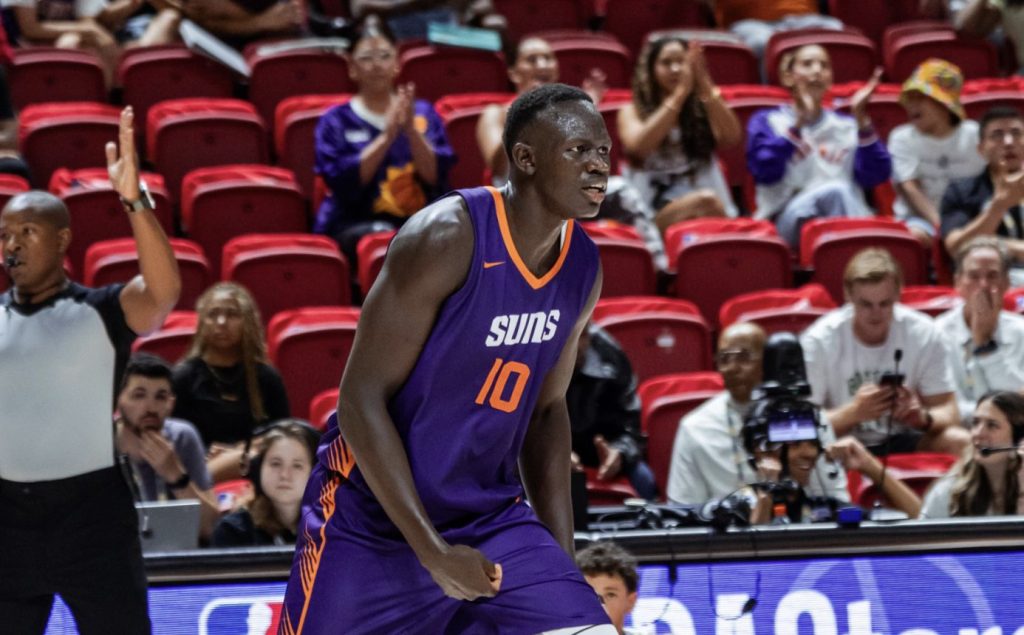
Khaman Maluach’s time at 2026 NBA Summer League has been as dominant as any Phoenix Suns fan, executive or player could’ve hoped for.
Through four games, the 19-year-old big is averaging 19.5 points, 12.8 rebounds, 2.0 blocks and 1.3 steals per game. He’s leading all Summer League players in rebounding average, he’s recorded a double-double in all four games, and he’s a +48 in his 109 minutes of action.
From his shot-blocking and rim deterrence, to his more commanding presence on the boards, to his imposing finishing above the rim, Maluach has looked the part of “10th overall pick ready to play a bigger role in Year 2.”
The question is how much room the Suns’ center rotation will give him to capitalize on those growth opportunities.
After all, Phoenix re-signed 24-year-old Mark Williams to a three-year, $38 million contract in free agency, and third-year big Oso Ighodaro brings a level of mobility, playmaking and switchable versatility that neither of the Suns’ other two bigs can offer. Even factoring in Williams’ injury history and the likelihood that he misses another 30-plus games, the competition for minutes at the 5 will be fierce.
However, there is one swing skill that could help ease that center logjam and shift the clash for minutes to the 3 and 4 spots instead. That swing skill is Khaman Maluach’s 3-point shot.
Because in addition to all the impressive numbers Maluach has put up in Las Vegas, the most tantalizing one might be his 8-for-20 shooting from downtown through four games. Granted, it’s Summer League, it’s a small sample size, and first and foremost, it was far more important for Maluach to show he could fulfill his big man duties against lesser competition.
But he’s done all that and more, and in the process, he’s showcased a more confident 3-point stroke…and the consistent results to go with it.
Although he only shot 1-for-4 in Monday’s win over the Milwaukee Bucks, Man Man started off his Summer League stint with a 3-for-7 performance against the Portland Trail Blazers, followed by a 2-for-4 outing against the New Orleans Pelicans. And then in Wednesday’s win over the Detroit Pistons, he went 2-for-5 from deep.
More importantly, he’s made at least one 3-pointer in each appearance, and did we mention that he’s shooting 40 percent from 3-point range?
Or that he’s learning from Kyle-Freaking-Korver?

Even as a rookie, Maluach’s jumper looked fine from a technical standpoint. But the confidence, conversion rate and game-to-game consistency all stand out, even in a Summer League setting where we often see players experiment with certain skills they won’t get the opportunity to try out in the big leagues.
So if Khaman Maluach’s 3-ball is real, and if he can just knock down 3s at, say, a 36 percent clip or better, what does that do for the Suns’ offense and Jordan Ott’s rotation?
For starters, it gives Maluach another path to minutes as part of dual-big lineups. Ott didn’t utilize them much last year, but he has plenty of experience in that arena from his time as an assistant coach with a Cleveland Cavaliers squad that started Evan Mobley alongside Jarrett Allen.
Maluach and Mark Williams might lack the mobility to hold up defensively if they’re sharing the floor together, but pairing Khaman with Oso Ighodaro would be worth a look. Offensively, the hope is that Maluach’s 3-ball and Oso’s playmaking could adequately space the floor, and on the other end, Ighodaro’s versatility would see him function as the “4” while Maluach protects the rim.
Even if Ott veers away from dual-big configurations (or they don’t work), Maluach has done enough to prove he deserves a more consistent role this season. One source told Suns After Dark months ago that they could envision a scenario where he surpasses Mark Williams as the starting center by the end of the season.
Whether he’s starting or coming off the bench, if Maluach’s 3-ball is a legitimate tool in his bag, there will be no excuse for keeping him glued to the bench, especially when his combination of size, length and rim protection is an undeniable asset that neither Williams nor Ighodaro brings to the table.
Remember, opponents shot 19.8 percent worse than they’d normally shoot at the rim last year whenever Man Man was contesting, which blew Ighodaro (5.1 percent worse) and Williams (0.1 percent better) out of the water. It should be noted that Ighodaro and Williams defended three times as many rim shots as Maluach, but that -19.8 percent figure is still pretty damn impressive!
Barring a Mark Williams trade, carving out minutes for Maluach would have a trickle-down (trickle-up?) effect on the rotation, since the Suns are already crowded at the 4-spot between Miles Bridges, Rasheer Fleming, Ryan Dunn and Koa Peat. Ott could always shift one or two of those guys up to the 3-spot, or even occasionally play Fleming as a small-ball 5, but that’s a lot of guys who are best-suited as 4s vying for minutes.
Bridges will undoubtedly start, and regardless of what he’s done or not done at Summer League, Fleming was too impactful as a two-way glue guy last year to not stick in the rotation in Year 2. That theoretically makes Dunn and Peat the odd men out, since Dunn already saw inconsistent minutes last year and Peat is still a rookie. But it’s too early for the Suns to give up on Dunn’s development in Year 3, and Peat has flashed enough in Vegas to warrant at least a chance at earning real minutes.
However, if Ighodaro is spending time as a “4” in dual-big lineups with Maluach, suddenly those opportunities for Dunn, Peat and even Fleming are getting slashed, unless Ott starts deploying someone as a backup 3 behind Dillon Brooks. There’s a domino effect to every rotation decision Ott makes, but the logjam at the 4 shouldn’t prevent him from deploying dual-big lineups if Maluach can actually space the floor.
Moreover, the Suns need all the 3-point shooting they can get. We’ve gone through this before at Suns After Dark, but in the wake of the regrettable Miles Bridges trade, the projected starting five is pretty sparse on efficient 3-point shooting:
- Devin Booker: 35.2% from 3 for his career, 33.0% last year
- Jalen Green: 33.9% from 3 for his career, 31.3% last year
- Dillon Brooks: 35.3% from 3 for his career, 34.4% last year
- Miles Bridges: 33.8% from 3 for his career, 33.3% last year
- Mark Williams: 5 3-point attempts in his entire career
Booker will always command defense’s attention as soon as he crosses half-court because he’s Devin Booker, and Collin Gillespie and Luke Kennard will bring plenty of 3-point efficiency (and hopefully volume) off the bench, but beyond that? The floor-spacing might get pretty tight.
Even in the second unit, Ighodaro doesn’t have a jump shot outside of his patented push shot, Ryan Dunn “improved” from 31.3 percent as a rookie to 33.1 percent on low volume, and the biggest knock on the incoming rookie, Koa Peat, is that he can’t reliably knock down 3s (and is currently undergoing the process of revamping his shot).
Maybe Rasheer Fleming keeps shooting at the 40.5 percent clip he posted from deep after entering the rotation in February, and maybe Haywood Highsmith earns enough minutes for his efficient 3-ball to make an impact, but Khaman Maluach may already be one of the Suns’ best 3-point shooters.
That can either be interpreted as a testament to his immense progress as a shooter, or an indictment on the roster Phoenix has assembled. Hopefully Maluach is able to knock down enough 3s for it to lean toward the former, rather than the latter.
In any case, Maluach isn’t some perfect prospect. He’s a second-year player who’s still prone to making mistakes on the defensive end, bobbling catches in traffic, and losing the ball when the Suns ask him to handle a little too much on the perimeter.
But the upside is immense, and the future needs to start now. Even with Williams back on a (tradeable) three-year contract, Khaman Maluach is ready to break out, and if the 3-ball really is part of his arsenal now, the Suns will have a lot more options at their disposal in a suddenly crowded frontcourt.
For more of Gerald Bourguet’s Suns work, check back with Sports360AZ on a weekly basis, subscribe to his Patreon articles and podcast at Suns After Dark, or follow him on Twitter.
Related posts:



Sports360AZ

We provide exclusive Arizona sports stories from the pros, college, and high school levels. Bookmark our site or follow us on Twitter or Facebook for all your local sports news!