
 Jeff Metcalfe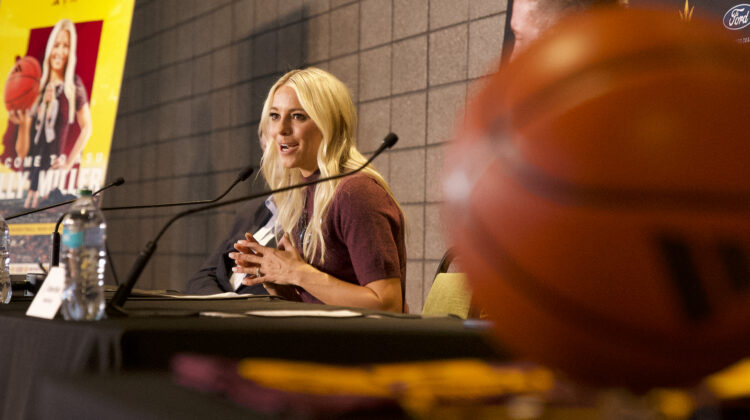
Even now with Arizona State women’s basketball officially into the NCAA Tournament for the first time since 2019, the season feels surreal.
How does a program with 29 combined wins in three previous seasons transform into a 24-win team under a new coach with 75 percent new players?
“It’s not normal,” admits guard Marley Washenitz, one of nine transfers to take a chance on Molly Miller and her coaching staff. “We wanted to leave the program better than we found it.” And personally to find something missing at other schools, three in their final year of eligibility.
The architect Miller experiences occasional moments of amazement.
“I didn’t have much to sell but a vision,” the 40-year-old says. “My vision was we’re going to flip this thing and I want you to be the turning point in getting this program back to its rightful spot.”
That recruiting mantra would carry Miller, hired the day after her Grand Canyon team lost an NCAA Tournament first-round game at Baylor, through a hectic six weeks almost exactly a year ago that laid the foundation for a 14-win improvement over 2024-25 (10-22). Only two schools nationally made a bigger win total jump, neither from a power conference.
Prioritizing competitors
Miller’s hiring was March 22 and introductory press conference four days later.
By April 2, eight ASU players were in the portal looking for new schools while Miller was scrambling to fill a staff that would help identify and recruit replacements.
That staff was officially announced April 17 although before then it was known that Jason Glover was following Miller from Grand Canyon and that Stephanie Norman was leaving Louisville to return to her alma mater ASU. Both are at the associate head coach level with Norman also director of basketball strategy.
“I wasn’t shy,” Miller says of pitches to Norman and Louisville head coach Jeff Walz that convinced Walz to support Norman leaving him after 18 seasons. “I not only wanted her but needed her.”
By April 14 when Norman announced her return to Tempe, where she played basketball from 1984-88, Miller already had her first three portal acquisitions in guards Jordan Jones and Gabby Elliott and forward McKinna Brackens.
“We probably had 14-15 visits in about 12 days,” Miller says. “It was wild. You want to rely on your players to help you recruit, but we had no one really here.”
Except for holdovers Jyah LoVett, Makayla Moore and Timya Grice with only LoVett having a significant role in 2024-25. “They were able to almost give us a (campus) tour as we were giving recruits tours,” Miller says. “We showed Makayla’s apartment every single time.”
Intentionality and alignment had precedence over talent in building a roster.
“We prioritized competitors,” Miller says. “Players who really embrace accountability. They had a little edge that they wanted to win and wanted to compete. Then just embrace change.”
10 incoming players
Jones, transferring from University of Denver, and Elliott (Penn State) chose ASU on April 7 followed by Brackens (UNLV) four days later.
They were joined April 17-23 by guards Marley Washenitz (Pitt), Last-Tear Poa (LSU), Amaya Williams (freshman who initially signed to play for Miller at GCU) and forward Heloisa Carrera (Mississippi). Then in early May by posts Martina Fantini (from Italy) and Deborah Davenport (Northwest Florida junior college). The 10th and final piece in mid-summer was guard Acacia Hayes (Western Kentucky).
Jones and Hayes sat out this season due to injuries. All the others have been contributors up to All-Big 12 third team level for Elliott and Brackens. Career-best play from them and others is exactly what ASU athletic director had in mind when hiring Miller after her 117-38 success in five seasons at Grand Canyon.
“Now more than ever in college sports, you’re betting on young people,” says Rossini, now searching for a new men’s basketball coach. “You’re helping them to understand that they’re more talented and capable than they even know. That’s where good coaching and good teaching really matters with people that have a track record of getting more out of the talent that they recruit.
“Saying I know they’re going to fit our system, I like the intangibles, I like the statistics, I like the recommendations, but we’re going to make this person better. That’s really still the pure purpose of college sports today. The world wants to take it down a different road but we still focus very hard on talent development in all the ways we can.”
In addition to Norman and Glover, Miller’s assistants are Daniel Barber, also recruiting coordinator, Daejah Bernard, who was with Miller at GCU, and Abi Olajuwon. Ashleigh Lopez worked her way up from graduate assistant to assistant coach at GCU with Miller. She now is the director of player development and recruiting operations in Tempe.
All part of an alignment contributing to a school record 15-0 start (tied for longest winning streak) that virtually no one saw coming.
“It’s a little bit stepping into the unknown when you put a bunch of strangers together but we did it quickly and we were able to change the reality quickly,” Miller says. “This staff, the players, every touchpoint of the program just had this phenomenal alignment. I still kind of pinch myself and say how did that work out as well as it did because everyone is on the same page and that doesn’t happen in year 1.”
Piecing the puzzle together
Every transfer tells a story, from their end and ASU’s.
Barber, for instance, coached Elliott at Clemson and Penn State. “We hit it off on the phone and she had that trust (with Barber) so it wasn’t a lot of convincing,” Miller says. “She knew she was going to be taken care of.”
Miller’s GCU team scrimmaged UNLV so Miller “had a front-row seat” to Brackens. “When she went in the portal I knew that’s a kid I would like to build with.”
Norman and Barber knew Washenitz from coaching against her in the ACC and told Miller she is “exactly your type of player.” Miller asked for specifics. Gritty, tough, non-stop motor, defensive stopper, willing to do little things. “She sounds like my type of kid,” Miller agreed.
Even last April, Washenitz had an inkling of what was possible at ASU
“Because they are such a great and experienced staff, turning it around (immediately) isn’t going to be a surprise or shock because I know they’re capable of doing that. Molly has proven she can win,” she said soon after her transfer.
Poa played three seasons at LSU including on the Tigers’ 2023 national championship team. She started 15 games in 2024-25 but her playing time this season might have decreased. At ASU, the Australian point guard has started 30 games, three more than her total LSU starts.
“Poa had a different dynamic than everyone else because she was a national champion,” Miller says. “She had competed at the highest level and I knew she had been coached up. I knew I could really push her and hold her to a high standard.”
Miller and Glover obviously knew all about Wiliams from successfully signing her at GCU out of Mater Dei High School in California. “It was a tough time for me,” Wiliams says of Miller leaving for ASU. “She wanted me to come play with her and I was so grateful for the opportunity. As soon as she asked me, I was in.”
Carrera, Davenport and Fantini were important gets because of their size (6-2 to 6-3) and multiple years of eligibility. They also are reflective of the staff using every recruiting avenue – major college transfer, junior college, international, freshman – to fill a 13-player roster.
Glover and Olajuwon get credit for developing the posts and particularly Carrera, who jumped from playing 63 total minutes as a freshman at Mississippi to being a full-time starter averaging 10.4 points and 5.3 rebounds.
“We got a young post player because we can develop her but then we were able to throw her into the fire,” Miller says. “She wasn’t afraid of that.”
Barber was familiar with Davenport from her winning two junior college national titles at Northwest Florida State. Miller calls her a “walking billboard for our brand” of defense and hustle. “I don’t know if she’s going to light up the box score, but she’s going to give us every intangible we want to build this program on.”
ASU wouldn’t have won a critical game against Oklahoma State on Feb. 4 without Davenport’s 18 points including 3-of-4 from 3-point and nine rebounds.
Fantini made a late recruiting decision to come to the U.S. from Italy and chose ASU after an extensive zoom call without visiting. “I was talking to her family and introducing her to my family,” Miller says. “I can’t really talk about family and not blend the two.”
Not everything can be fixed in one rushed portal cycle, but it’s worth remembering that ASU would be a better 3-point shooting team and have more scoring depth if Jones was not redshirting after foot surgery in October and Hayes did not suffer an ankle injury when she was about to return from a knee injury.
Jones and Hayes averaged double-figure scoring over three years at Denver and Western Kentucky. It’s not a stretch to think ASU would have some additional wins with that guard duo healthy.
Foundation for sustained success
Charli Turner Thorne sees brilliant orchestration in ASU’s resurgent season.
She did plenty of such conducting herself in 25 seasons as ASU coach with a school record 488 wins and 14 NCAA Tournament appearances, two of those reaching the Elite Eight.
Now in her Phoenix Mercury scouting and broadcasting era, Turner Thorne has been an analyst for enough ASU games to appreciate what Miller is accomplishing as the winningest first-year coach in school history.
That’s from talent acquisition to smart allocation of revenue sharing/NIL funds to build-up scheduling to player development to load management to Miller seemingly cloning herself to be everywhere at once for program visibility.
“It was very good evaluating and a great job coaching and getting them to buy in,” Turner Thorne says. “They found some really great pieces – some scorers, some defense, some people with their last chance, some people finally getting a chance. It was really thought out.
“There was nowhere to go but up but at the same time there’s a legacy of this program that you should be really good. Molly and her staff did a great job with that. They were hungry the entire season to win from day 1 until now. That’s not easy to find in this day and age.”
Whether or not ASU adds to its winningest season since 2015-16 (26 victories) in the NCAA Tournament starting Thursday against Virginia, the foundation is set for sustained success akin to what volleyball has strung together in three seasons under JJ Van Niel (86-14 combined record).
Elite guard Ruby Whitehorn, formerly at Clemson and Tennessee, already is on campus via transfer and ASU figures to be a sought-after portal destination. All of Miller’s November freshmen signees – guards Averie Lower, Londyn Parker and Quin’Nya Gray de Sanders – are coming off highly successful senior seasons. Guard Kaleena Smith, No. 1 nationally in the 2027 recruiting class, visited ASU in November and has an NIL partnership with Adidas, an ASU athletics sponsor.
“We’re not trying to build the entire roster,” Rossini says. “We’re trying to find 3-4 of the right pieces to bring them into a winning environment where people have already seen what coach Miller is capable of, they’ve already seen the style of basketball we play.
“Now we can attract talent that fits what we’re building and accelerate that climb and continue to pour momentum on what we’re doing.”
ASU is host institution for the NCAA Women’s Final Four on April 2-5, a world-wide platform that also will work in Miller’s favor because this team scrapped its way to be playing meaningful basketball in February and March.
“They’re very good at taking advantage of that,” Turner Thorne says. “Between Molly and Steph (Norman), they really promote. You have to have money and make sure your brand is standing out to these kids.”
Related posts:
 Gallery: ASU vs Texas Tech

(AP Photo/Amanda Loman)
ASU Football Wins Against Oregon State, Opts Out of Bowl Game
(AP Photo/Rick Scuteri)
Arizona Using “24 Minutes” to Move On From WSU Loss to Territorial Cup Best of the West WBB power rankings: USC sweeps UCLA, Cal climbs ahead of ACC tourney, GCU stays sizzling