
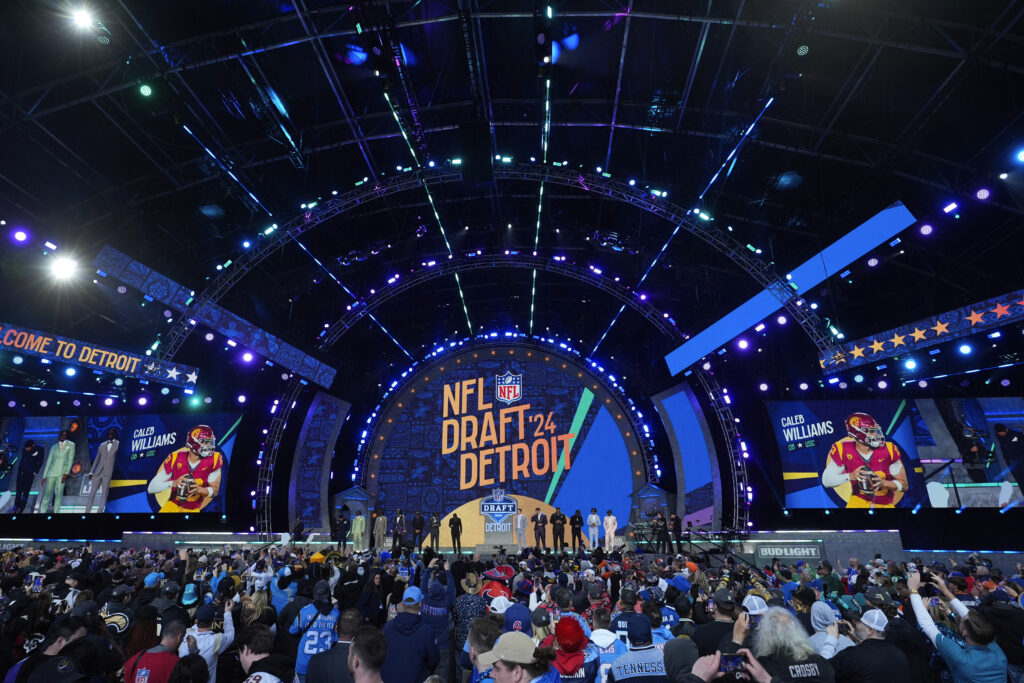
14 teams entered the NFL playoffs, and only two remain: the New England Patriots and the Seattle Seahawks. The question the other 14 teams must answer over the next couple of months is how to keep playing in February next year.
Each and every one of those teams will use the draft to fill in team needs. Here is one position each team should look at with their first pick in the 2026 NFL draft.
AFC
Jacksonville Jaguars (Lost 27-24 in Wildcard)
Jacksonville doesn’t have its first-round pick in this draft, having traded it to the Cleveland Browns in the 2025 NFL draft to allow them to select Travis Hunter. The Jaguars are currently slated to pick at 56 with their first selection.
The team generated a pressure rate of 36.8 percent against the Bills but recorded only one sack. Defensive coordinator Anthony Campanile brought pressure 34.2 percent of the time, ranking fifth highest among playoff teams. Bottom line: the Jaguars need to be able to win rushing four, so they don’t have to rely on blitzing to get pressure. Defensive tackle is a good start.
Some options the team can look at when they pick are Texas Tech’s Lee Hunter and Skyler Gill-Howard, who both had pass rush win rates of over 10 percent.
Pittsburgh Steelers (Lost 30-6 in Wildcard)
The Steelers need a quarterback. Aaron Rodgers will be 43 before next season ends, and despite the major needs, it’s one Pittsburgh hopefully doesn’t force. This roster has plenty of needs, and forcing a quarterback with pick No. 21 could be a costly mistake.
Pittsburgh has five picks in the first three rounds, giving them a lot of flexibility to address certain positions. Wide receiver should be the first one. The offense desperately needs an outside target opposite of D.K. Metcalf, and there will be solid first and second-round options. Denzel Boston, Germie Bernard, Omar Cooper Jr. and KC Concepcion should all be on the board at some point within the Steelers’ first two picks.
The offensive unit as a whole mustered only 175 yards of total offense, ranking last among playoff teams this season and posted an EPA per pass of -0.70, again last among playoff teams. The passing attack needs juice, and this draft has good answers for that.
Los Angeles Chargers (Lost 16-3 in Wildcard)
Justin Herbert was running for his life against the Patriots. Los Angeles gave up six sacks and a pressure rate of 36.4 percent. In one game, those six sacks are tied for second most among playoff teams. The team suffered injuries on the outside, with Joe Alt and Rashawn Slater sustaining season-ending injuries.
Still, the interior can use a boost, especially at the left guard position. Penn State guard Olaivavega Ioane specializes in pass protection. He’s sufficient at blocking in zone running schemes (perfect for the hiring of Mike McDaniel at offensive coordinator) and gave up zero sacks in the 2025 college football season.
Buffalo Bills (Lost 33-30 in Divisional Round)
The Bills’ top wide receivers going into their game against Denver were Khalil Shakir, Brandin Cooks, Keon Coleman and Mecole Hardman Jr. Not very thrilling. Wide receiver has to be an emphasis for the Bills in this draft, particularly one who brings a different body type than what they currently have.
At No. 26 overall, Washington’s Denzel Boston is a perfect fit, standing at 6-foot-4, 209 pounds. A big and physical target that Josh Allen can find down the field. He uses more physicality than speed to create separation, which is something the Bills offense hasn’t had out wide in quite some time.
Houston Texans (Lost 28-16 in Divisional Round)
If one thing’s clear, the Texans don’t need help on the defensive side of the ball. The offensive line is still a major need in Houston. The unit gave up 36 quarterback pressures in two games, ranking first among playoff teams.
While tackle depth isn’t necessarily thrilling in this year’s draft, there are still solid options at the end of the first round. Monroe Freeling, Blake Miller and Caleb Lomu are all potential options for the Texans to take a look at throughout this draft process.
Denver Broncos (Lost 10-7 in the Conference Championship)
The loss of Bo Nix just stings. The Broncos had a defense and offensive unit ready to make a Super Bowl appearance. But nothing can change the outcome of championship weekend; it’s time for Denver to reload this offseason to what’s already a very talented roster.
Despite having one of the NFL’s best defenses, the Broncos struggled to stop the run in the playoffs. Buffalo ran for 183 yards and New England, 141. With Alex Singleton potentially hitting free agency, linebacker could become a need for Denver, and at No. 30 overall, Georgia’s CJ Allen is a great option, having all the linebacker intangibles you can ask for.
NFC
Carolina Panthers (Lost 34-31 in Wildcard)
Man oh man, how close the Panthers were to knocking off the Rams early. Watching that game, defense screams as a defensive need for Carolina, particularly at the second level with the linebackers. The intermediate part of the field (10-19 yards) is where Stafford did most of his damage, yardage-wise, with 139.
Ohio State’s Sonny Styles would be a dream fit here, but he’ll most likely be gone by pick 19, and Georgia’s CJ Allen would be the next best available linebacker. If Carolina doesn’t feel Allen is worth the pick, they can also look to defensive tackle, specifically Lee Hunter or Christine Miller, both of whom have pass-rushing upside.
Philadelphia Eagles (Lost 23-19 in Wildcard)
The biggest need for Philadelphia is an offensive coordinator, but that’s out of my pay range. At No. 23, the Eagles need to find a corner opposite Quinyon Mitchell as Cooper Dejean plays in the slot. Tennessee’s Colton Hood would be a great fit for Philadelphia to help bolster the secondary that’s loaded with talent.
Green Bay Packers (Lost 31-27 in Wildcard)
Pass rush, pass rush and pass rush. Specifically, the Packers’ interior pass rush is a major need after they traded Kenny Clark before the season. Green Bay had a sack percentage of 1.9 percent, ranking second-worst among playoff teams. While a big part of that is Caleb Williams being, well, Caleb Williams, an upgrade is needed regardless.
They don’t have a first-round pick due to the Micah Parsons trade, so their first selection comes at pick 52. Lee Hunter, Christen Miller and Skyler Gill-Howard are all potential choices, with Howard the most likely to be available at 52.
San Francisco 49ers (Lost 41-6 in Divisional Round)
Injuries derailed the 49ers’ season, but regardless, San Francisco has needs. Wide receiver is a great start. With Jauan Jennings set to be a free agent, if he’s not re-signed, the top two wideouts are Ricky Pearsall and Demarcus Robinson.
Insert Texas A&M’s KC Concepcion. He’s the ideal fit for Kyle Shanahan’s system, being creative after the catch and having superb route-running at all levels. If he’s there at pick 27, it’d be hard to imagine the 49ers passing on him.
Chicago Bears (Lost 20-17 in Divisional Round)
Bears need help at generating pressure, specifically from the edge. Luckily for them, this draft is loaded with talented edge rushers. Picking at No. 25 overall, there are some quality options in Auburn’s Keldric Faulk and Miami’s Akheem Mesidor.
Los Angeles Rams (Lost 31-27 in Conference Championship)
The Rams had a rollercoaster of a ride at the cornerback positions throughout the 2025 season. At one point, Emmanuel Forbers Jr. looked like the answer for Los Angeles at corner, but in the last couple of weeks, it’s become clear they need a new starter at the corner position.
Lucky for the Rams, they own the Atlanta Falcons’ first-round pick and will pick at No. 13 and No. 29 overall. LSU’s Mansoor Delane and Tennessee’s Jermod McCoy both could be available at 13, instantly being home run picks for general manager Les Snead.
A potential and interesting option for the Rams is trading up to select Ohio State safety Caleb Downs. While he’s not a clear-cut need, he has the versatility and IQ to become a dominant force in the NFL.
Related posts:
 VIDEO – Brock Purdy Graduating, Getting Ready for 2022 NFL Draft
LSU quarterback Garrett Nussmeier (18) (AP Photo/Rogelio V. Solis)
Daniel “The Draftnick” – Some of College Football’s best face off this Saturday
Southern California wide receiver Makai Lemon (6)(AP Photo/Craig Pessman)
Daniel “The Draftnick” – WRs other than Jordan Tyson to watch for 2026 Draft
(AP Photo/Darron Cummings)
Daniel the Draftnick – Early Look: The Quarterbacks in the 2026 NFL Draft ClassSports360AZ
We provide exclusive Arizona sports stories from the pros, college, and high school levels. Bookmark our site or follow us on Twitter or Facebook for all your local sports news!