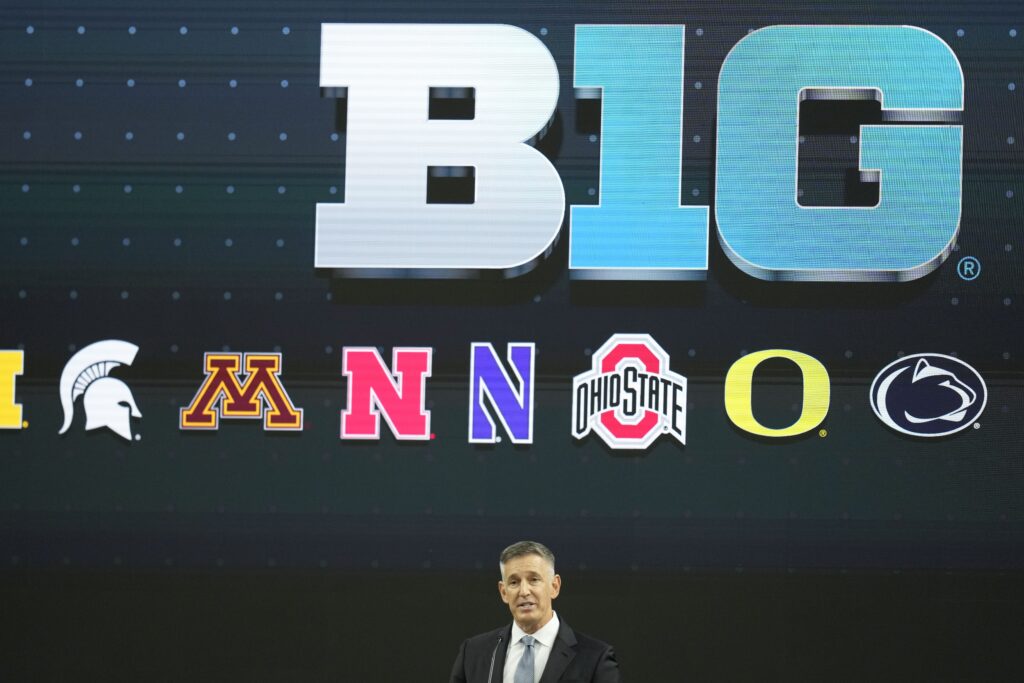
RANCHO PALOS VERDES — Big Ten commissioner Tony Petitti concluded the second day of his conference’s spring meetings Tuesday with an hour-long session with the media. All but one minute (or so it seemed) was spent on the most controversial topic in college sports: The Big Ten’s proposal for a 24-team College Football Playoff.
Petitti’s radical plan to double the size of the field has the full support of Big Ten coaches and athletic directors but generated a lukewarm response from fans — that’s probably putting it kindly — and staunch opposition from the only entity that matters: The SEC.
The Big Ten and SEC control the playoff’s future format. Until or unless they agree on the size of an expanded field, the event will continue with 12 teams.
SEC commissioner Greg Sankey has repeatedly stated a preference for incremental expansion to 16 teams.
When asked how much time the Big Ten has spent this week discussing 16, Petitti said: “zero.”
In his most in-depth public comments on the 24-team proposal, Petitti described his conversations with Sankey as “candid and open.”
“We work really well together,” he added. “That doesn’t mean you always agree.”
The SEC’s spring meetings are scheduled for next week in Destin, Fla., after which Petitti and Sankey will have another round of conversations. Under the terms of a memorandum of understanding signed in the spring of 2024, the Big Ten and SEC are required to merely consult with the Big 12, ACC and Group of Six conferences.
In order to expand the field in time for the 2027 season, the Big Ten and SEC must reach an agreement by Dec. 1.
“If we have to wait, it’s OK,” he said. “We’ll wait.”
Petitti pushed back on the criticism of his plan, which grants one automatic bid to the best team in the Group of Six conferences and reserves 23 at-large spots for teams chosen by the selection committee.
The top-eight seeds would receive opening-round byes, with No. 9 playing No. 24, No. 10 facing No. 23, etc. Games would be played on the home field of the higher seeds, with the winners advancing to face the top-eight seeds, which would have home games in the second round.
Atop the list of concerns for skeptics: The 24-team playoff would devalue the regular season, making big games less meaningful for highly-ranked teams whose CFP participation was assured.
After all, the expanded format would include a bevy of teams with three losses and perhaps a few teams with four.
“The system has tiered incentives,” Petitti said. “(Teams) would always be trying to improve their resume … That’s what a good playoff structure does.”
He outlines scenarios in which:
— Teams near the bottom of the selection committee rankings would be motivated to secure bids.
— Teams in the middle of the rankings would want to lock in home games in the opening round.
— Teams on the top tier to the rankings would be incentivized to secure opening-round byes (and home games in the second round).
Petitti also believes the 24-team field would empower teams to schedule challenging non-conference games because they would not view a loss as dooming their CFP prospects.
“When you go to 24,” he said, “you unlock a lot of really good ideas about how you schedule.”
The plan reflects a significant change from the Big Ten’s position last year at this time, when Petitti proposed a 16-team playoff field in which only three spots were awarded on an at-large basis. The remainder were reserved for automatic qualifiers from the power conferences.
The proposal met stiff resistance from the SEC, ACC and Big 12, so Petitti and his staff went back to work and eventually settled on a 24-team field that was heavy on automatic qualifiers.
Again, there was resistance.
Another revision led the Big Ten to the format currently under consideration: 24 teams with 23 at-large spots. Support from the ACC and Big 12 quickly followed.
Meanwhile, the SEC is committed to 16 — at least for now.
Asked about his concerns with 16, Petitti cited the lack of new revenue, especially if the lucrative conference championship games were abolished, and limited access compared to a 24-team field.
According to the Big Ten, 80 schools would have qualified for a 24-team playoff had the format been in place when the CFP was implemented in 2014.
“We’re working hard to figure out ways to get to a solution,” Petitti said. “Inside our league, there’s a deep commitment to 24.”
*** Send suggestions, comments and tips (confidentiality guaranteed) to wilnerhotline@bayareanewsgroup.com or call 408-920-5716
*** Follow me on the social media platform X: @WilnerHotline


 Pac-12 survival guide: Examining the Fear Index as vultures circle and uncertainty looms

 Mailbag: Big 12 threat level (in the CFP), Wilcox’s future, Washington’s QB plans, Pac-12 expansion, my AP ballot and more Could the Big 12 get nudged aside by a Group of Five team in the seeding process?