
 Jon Wilner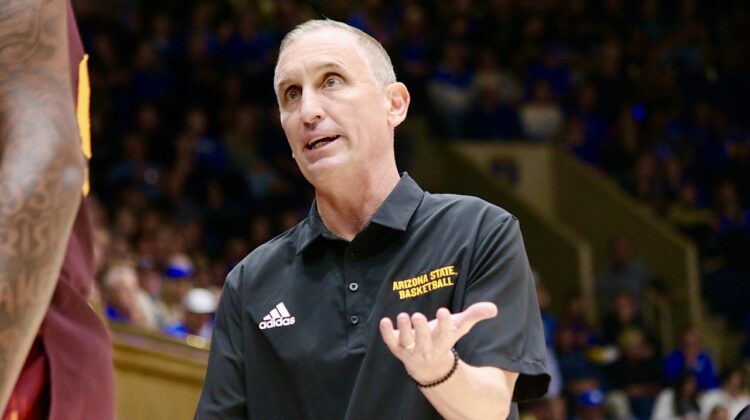
The sloppy start came first, followed by the technical fouls, the lopsided halftime score and the embarrassing loss — the worst of the Bobby Hurley era, all wrapped in 40 minutes of abject ignominy.
Hours later, the walking papers arrived. Arizona State dismissed Hurley on Wednesday after a 49-point loss to Iowa State in the Big 12 tournament capped yet another mediocre season.
The move had been expected for weeks, if not months, given that Hurley was coaching in the final year of his contract. On multiple occasions, Hurley himself hinted the bell was set to toll following an 11-year tenure in Tempe that left a range of impressions:
Hurley underachieved given everything the university has to offer.
Hurley overachieved given everything the university failed to provide.
He should have been fired years ago.
He didn’t deserve to go out like this.
“It’s been a long road; it’s been a special time,” Hurley said after the 91-42 meltdown but before his dismissal became official.
“I’m not sure what’s going to happen because I don’t know. I haven’t spoken directly about my future. But I don’t have any regrets. I have laid it out on the line to the best that I could every night … I did it until the last buzzer sounded.”
Hurley’s departure came two days after his predecessor in Tempe, Herb Sendek, seemingly clinched an improbable NCAA Tournament bid with Santa Clara by defeating Saint Mary’s in the semifinals of the West Coast Conference tournament. It will be the Broncos’ first trip to March Madness in 30 years, since Steve Nash’s senior season.
Remember Sendek’s tenure with the Sun Devils? He collected five 20-win seasons and two NCAA Tournament bids but was axed after nine years on the job.
Hurley lasted 11 years, reached March Madness three times and posted four 20-win seasons.
That’s two decades in totality, with five NCAA appearances.
You know how many times the Sun Devils reached the NCAAs in the 30 years prior to the Sendek-Hurley eras? Five times.
Five times in 30 years, then five times in 20 years.
That’s one trip to March Madness every five years.
It’s a tough gig, folks.
Sendek and Hurley are good coaches — Sendek has been named Coach of the Year in four conferences — who performed above Arizona State’s historical standard but were ultimately deemed not good enough.
Is there any reason to think the next coach will haul the Sun Devils out of the morass, challenge Arizona for in-state relevance, compete for Big 12 titles and make regular trips to the NCAAs?
Hurley’s successor will have the benefit of working with Graham Rossini, the most competent athletic director the Sun Devils have employed in eons.
And he will be working with the promise of a new home court. Desert Financial Arena, an eyesore constructed in the Jurassic Period, will undergo a $100 million renovation.
Also, there are indications (e.g., the DFA remodel) that university president Michael Crow plans to support men’s basketball at a level not seen in the Hurley or Sendek eras.
So, yes: Hurley’s successor has a chance.
The Sun Devils could hire a proven winner with decades of experience or a rising star. A slew of candidates will pursue the job, hoping for the chance to coach in one of the nation’s best basketball conferences. (In our view, their top target should be Saint Mary’s coach Randy Bennett, who grew up in Mesa.)
But a refurbished arena, a sharp athletic director and a supportive president won’t be enough to ensure success, not given the inherent challenges.
The Sun Devils are the No. 2 college basketball program in the state and, at best, the No. 5 team in their market. Traction has proven elusive in metro Phoenix. They have a spotty tradition, inconsistent fan support, and a constituency that has always favored football.
It’s not impossible for ASU to eventually join Arizona, Kansas and Houston on the Big 12’s top tier, but a first-rate coach is merely part of the equation. The Sun Devils must locate the cash required to construct a roster that can compete at the highest level.
For basketball programs at football schools that don’t have billionaire donors or 100,000-seat stadiums, that’s a monumental challenge.
Every dollar available through revenue sharing or generated by NIL opportunities must be plowed into football, because football is Arizona State’s ticket out of the Big 12 and into the next era.
That era could feature a super league with 32 or 42 teams or a super-sized Big Ten with 24 or 28 members. The shape is uncertain, but the timing is clear: By the end of the decade, the next iteration of major college sports will be set.
For the Sun Devils to be included on the top tier, they must thrive on the field. And to thrive on the field, they need $15 million in revenue sharing and another $10 million in NIL.
How much will remain for men’s basketball?
The Sun Devils aren’t alone, by the way. The same issue exists at Utah and Colorado, at Cal and Washington. Even UCLA must lean into football more than it has in the past.
But without adequate financial resources, the next coach will fare no better than Sendek or Hurley. ASU will occupy a position on the Big 12’s second tier, an occasional participant in the NCAAs.
We aren’t taking issue with Arizona State’s decision. Hurley should be commended for winning as much as he did under the circumstances — Sendek, too — but his tenure had run its course.
But to leave their past and present behind, to escape the long shadows of mediocrity, the Sun Devils need a top-notch coach and so much more. They need internal alignment, institutional resources, community support and cold, hard cash.
So steep is the challenge ahead that the unthinkable could unfold in Tempe in the years to come, with fans looking back longingly on the era that came to a close Wednesday.
*** Send suggestions, comments and tips (confidentiality guaranteed) to wilnerhotline@
*** Follow me on the social media platform X: @WilnerHotline
Related posts:
(AP Photo/Ralph Freso, File)
Hotline Mailbag – Options if the Pac-12 raids the Big 12, The Apple-12 Conference? Pac-12 bowl projections: The CFP challenge, Utah repeats, USC gets squeezed and eight teams qualify

(AP Photo/Damian Dovarganes, File)
Saturday Night Five: Oregon and Washington rise, ASU and Colorado slide, the playoff outlook and across-the-board improvement Wilner’s Saturday Night Five – Arizona State sizzles, CW first-rate broadcasts, Oregon O-line struggles, more.