

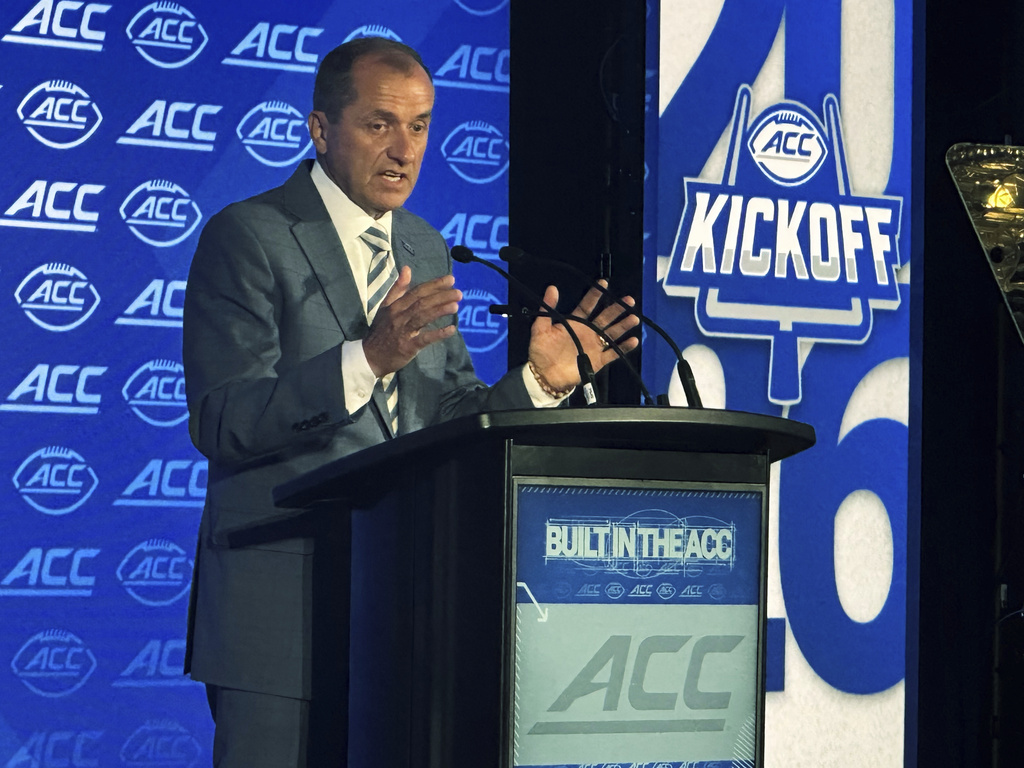
Commissioner Jim Phillips addressed all the hottest topics Wednesday during his on-stage appearance at ACC football media days in Charlotte, from the conference’s new tiebreaker policy to the Protect College Sports Act on Capitol Hill, from the threat of SEC and Big Ten breaking away from the NCAA to expansion of the College Football Playoff.
His tone was measured but upbeat, free of controversy and well received.
In that regard, the ACC’s turn in the mid-summer spotlight differed markedly from the Big 12 version that unfolded last week in Frisco, Texas and generated suboptimal reaction on two fronts: Commissioner Brett Yormark’s refusal to comment on the Brendan Sorsby affair (and his relationship with Texas Tech); and the sweeping sponsorship deal with Monster Energy that drew instant criticism for its modest value (reportedly $1.25 million per school).
 The disparate developments in Charlotte and Frisco might seem insignificant against the backdrop of the season to come, but they reflect an emerging theme that should not be ignored: the growing inequality among unequals.
Five years after the onset of realignment, the term Power Four feels increasingly antiquated — a largely inaccurate and wholly wistful framing of the competitive landscape specific to the ACC, Big 12, Big Ten and SEC.
Powered by membership expansion and flush with more than $1 billion in annual revenue, the SEC and Big Ten have ascended to a higher level. They dominate the weekly rankings and TV ratings, control CFP expansion and gobble the playoff bids.
The ACC and Big 12 aren’t merely lacking in equality relative to the Power Two; they are becoming dissimilar to each other.
To spot the distinction forming on the sport’s second tier, there is no need to squint:
— The ACC is separating from the Big 12 financially.
Phillips announced Wednesday that the conference generated more than $900 million in gross revenue in the 2026 fiscal year. The Big 12? According to Yormark, gross revenue for FY2026 will be a tick over $700 million.
One layer down, the contrast is equally glaring: The ACC is expected to distribute an average of more than $50 million to its full-share members in FY2026, while our projections for the Big 12 suggest each of the 16 campuses will collect approximately $40.5 million.
(Details won’t be available until next spring, when federal tax filings are made public.)
Notably, that $10 million difference per campus likely will repeat each year through the end of the current media rights cycle.
— Another disparity: internal peace.
The ACC quelled a revolt by Florida State and Clemson in the spring of 2025, leaving the 17 schools reasonably content with the state of affairs, thanks in large part to a success initiative crafted by Phillips.
Meanwhile, the Big 12 is anything but harmonious, with Texas Tech assuming the role of school bully.
The friction isn’t confined to the Sorsby affair, which prompted the conference to take the Red Raiders to court over their egregious attempt to play a quarterback who had gambled on his own team (while at Indiana).
Just a few months ago, the Red Raiders complained publicly and repeatedly about being required to play on Friday (at Houston) — to the point that billionaire donor Cody Campbell seemed to taunt Yormark on social media, writing: “Apparently Brett didn’t get the memo: EVERYTHING RUNS THROUGH LUBBOCK!!”
The hubris is something to behold considering Texas Tech has the same number of playoff wins as UCF (zero).
— The difference between the ACC and Big 12 is perhaps best framed by what the former has not done in the past few months.
It has not used a glass basketball court for its conference tournaments, as the Big 12 did in March.
It has not partnered with a private equity firm to make cash available to its schools and the conference office, as the Big 12 did in April.
And it has not sold naming rights to its primary products, as the Big 12 did earlier this month. (Say hello to Monster Energy Big 12 Football and Monster Energy Big 12 Basketball.)
— Lastly, there is a clear distinction in the area that arguably matters most: the College Football Playoff.
Across two seasons of the 12-team event, the ACC has not only won games (Miami in 2025) but also placed two teams in the field in a single year (Clemson and SMU in 2024).
The Big 12 has done neither. Only its champions have participated (Arizona State in 2024 and Texas Tech in 2025), and both lost their first game.
And that, folks, is a fine place to end this discussion.
Because for all the optimism percolating from ACC territory and all the concerning trends in the Big 12 footprint, the narrative can flip in a matter of months. It only takes a CFP victory or two to change the optics.
Inequality among the unequals isn’t necessarily a fixed state.
Other notable comments by Phillips during his session with the media:
— On the Protect College Sports Act, which is currently working its way through the Senate: “It’s a chance to stabilize the future of college athletics,” he said. And if the legislation doesn’t pass? “That’s on us.”
— On the lawless nature of college sports: “There’s a failure to have restraint like I’ve never seen before — tampering, expenditures, a failure to work collaboratively as much as we should. That has to change.”
— On the potential for the SEC and Big Ten to break from the NCAA and create self-governing models: “Self-governance, to me, means no governance.”
— On realignment and whether the ACC would consider expansion: “I’ve always wanted this conference to be a place where schools want to be, not that they have to be.”
*** Send suggestions, comments and tips (confidentiality guaranteed) to wilnerhotline@
*** Follow me on the social media platform X: @WilnerHotline
Related posts:

(AP Photo/Godofredo A. Vásquez)
Wilner – Cal, Stanford football programs at crossroads: Our to-do list for the new campus leaders as the prepare for ACC life Wilner Mailbag: WSU’s media value (market vs. ratings), the digital factor, schedule options, a coaching hypothetical and more
 On CFB media: Fox’s depleted inventory options, the ‘Big Noon’ plan and Colorado’s lower but enduring popularity
Saturday Night Five: Breaking the Big 12’s four-team tie (ASU controls its fate), Cal and Oregon State rise, USC survives
On CFB media: Fox’s depleted inventory options, the ‘Big Noon’ plan and Colorado’s lower but enduring popularity
Saturday Night Five: Breaking the Big 12’s four-team tie (ASU controls its fate), Cal and Oregon State rise, USC survives
Jon Wilner

Jon Wilner has been covering college sports for decades and is an AP top-25 football and basketball voter as well as a Heisman Trophy voter. He was named Beat Writer of the Year in 2013 by the Football Writers Association of America for his coverage of the Pac-12, won first place for feature writing in 2016 in the Associated Press Sports Editors writing contest and is a five-time APSE honoree.